А что там на РФ ?

Jan. 27th, 2026 10:41 am
southwest: (heidi)
[personal profile] southwest
Заместитель гендиректора ЦМАКП Дмитрий Белоусов заявил, что россиянам не стоит ждать дальнейшего роста зарплат. По его словам, экономика достигла своего предела. Ситуация ухудшается, прибыль бизнеса падает, а доходы в большинстве отраслей снижаются.

Денег нет, но вы держитесь! Всего вам доброго, хорошего настроения!

Заместитель руководителя администрации президента Сергей Новиков заявил, что 250 тысяч демобилизованных военных (ветеранов СВО) нигде не работают. Об этом сообщило агентство РИА «Новости». Однако вскоре публикацию отредактировали: конкретную цифру убрали, написав «десятки тысяч». Четверть миллиона антисоциальных элементов с неплохой военной подготовкой. Однако, есть и положительный момент: предыдущая новость о стагнации зарплат их никак не коснётся.

Производители продуктов продолжают политику шринкфляции: теперь в магазинах всё чаще встречаются пачки сливочного масла по 160 грамм (вместо 180) и бутылки молока по 800 мл. Цены на говядину и твёрдые сыры за январь выросли на 15%, превращая их из продуктов первой необходимости в деликатесы "по праздникам".
[syndicated profile] zeroh_feed

Posted by Tyler Durden

Southwest Airlines Ends Open Seating, Moves To Reservation-Based System

Authored by Rob Sabo via The Epoch Times,

Southwest Airlines’ era of offering passengers open seating is officially ending, as the passenger carrier transitions its seating policy to a reservation-based system common with other airlines starting on Jan. 27.

Southwest announced last summer that it would end its open seating policy to offer customers a wider range of seating options. The airline’s new booking model includes three seating options: standard seating at the back of the aircraft; preferred seating near the front; and extra legroom seats in the front of the cabin and at the exit rows.

Southwest said it will also initiate a new group-based boarding process to replace its old “A,” “B,” and “C” boarding system that encouraged travelers to check in 24 hours prior to departure to secure the coveted “A” boarding option. The new boarding system will be skewed toward passengers who book premium seating options, while customers who choose basic seating will board last. Southwest will need to make physical changes to its departure gates to accommodate the new system, which could take months to complete.

Tony Roach, Southwest Airlines’ executive vice president of customer and brand, said the changes allow customers more choice and control over their flying experience.

“Assigned seating unlocks new opportunities for our customers—including the ability to select extra legroom seats—and removes the uncertainty of not knowing where they will sit in the cabin,” Roach said in a statement announcing the booking shakeup.

“This is an important step in our evolution, and we’re excited to pair these enhancements with our legendary customer service.”

The airline’s new “basic” fare option—formerly called Wanna Get Away—is nonrefundable and does not allow any changes in travel dates or times unless passengers upgrade to a higher tier. Choice Extra is the new name for its former business select option and includes two free checked bags along with priority boarding.

Southwest said on its website that the new booking policy for the extra legroom seats may clash with existing corporate business accounts, which offered priority boarding so business travelers could get first dibs on seats in the front of the plane or those with extra legroom.

“We recognize these changes may impact how business customers interact with Southwest Business,” the airline said. “We are actively working through details on how best to offer updated contractual benefits into future corporate travel agreements, and we will strive to keep you informed on any updates.”

The airline also announced it would change its policy regarding larger travelers who require more room. Starting Jan. 27, passengers who don’t fit within a seat’s armrests will be required to purchase an additional seat. Previously, the airline offered larger passengers the option to purchase a fully-refundable seat or ask for a free one at the gate.

Southwest Airlines’ final flight featuring open seating departed from Honolulu on Jan. 26 and arrived in Los Angeles this morning.

Southwest Airlines has offered open seating since its first flights to Houston and San Antonio from Love Field in Dallas in the summer of 1971. The company went public on the New York Stock Exchange in 1977.

Tyler Durden Tue, 01/27/2026 - 10:30
[syndicated profile] zeroh_feed

Posted by Tyler Durden

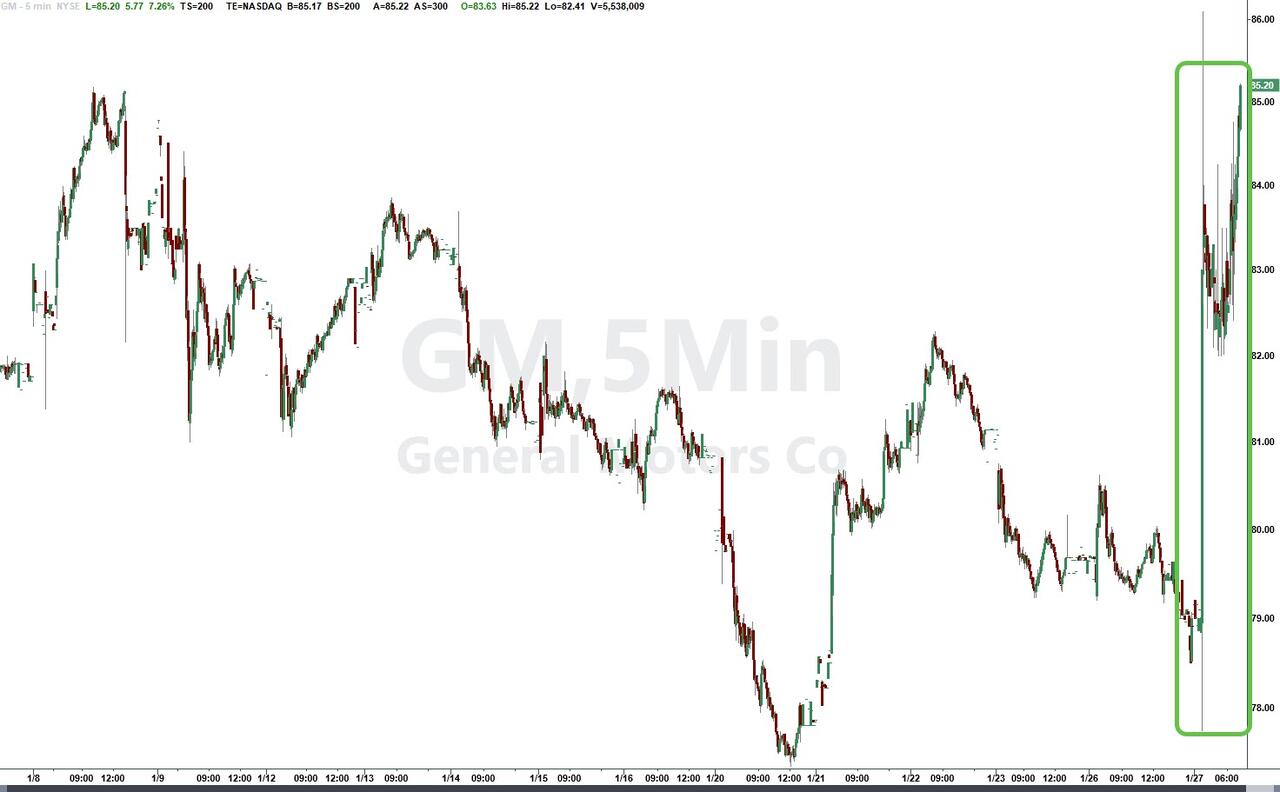
GM Shares Surge 7% After Surpassing Q4 Estimates, Raising Guidance, Planning $6B Stock Buyback

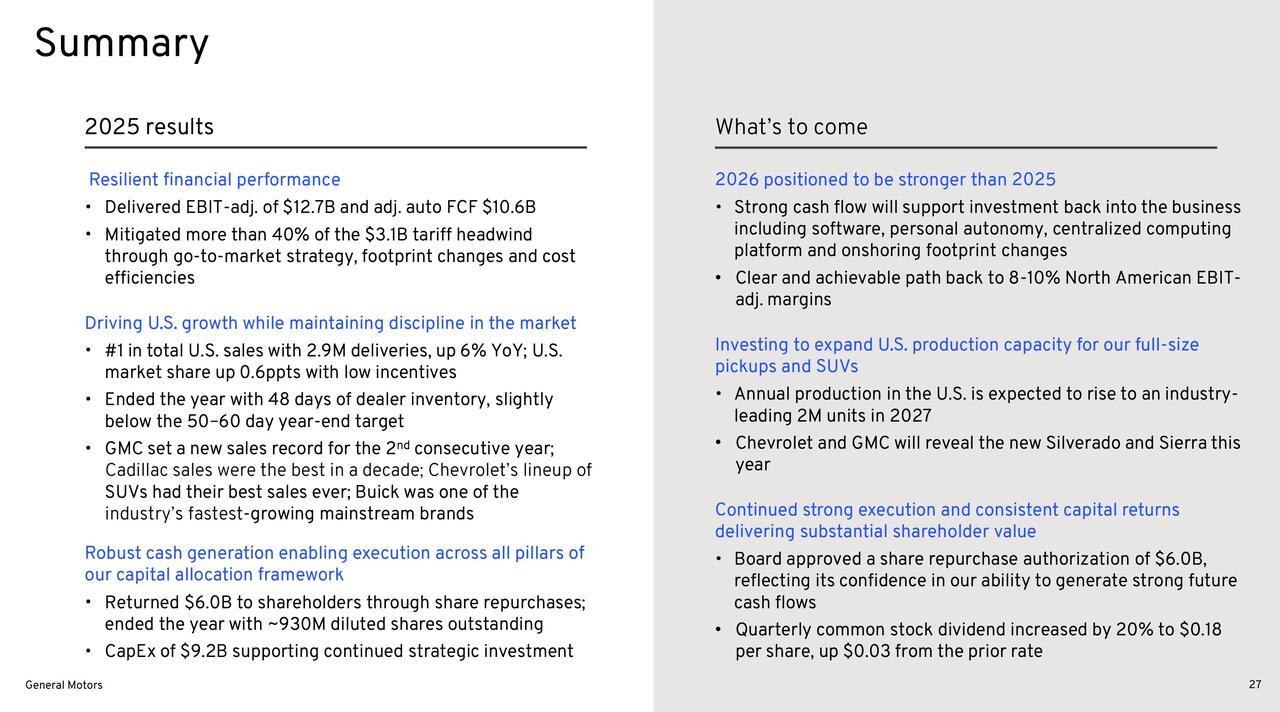
General Motors exceeded Wall Street’s fourth-quarter earnings expectations and forecast another year of “strong financial performance” in 2026. While revenue fell slightly short, the company announced a 20% dividend increase and a new $6 billion stock buyback program, according to CNBC and GM.

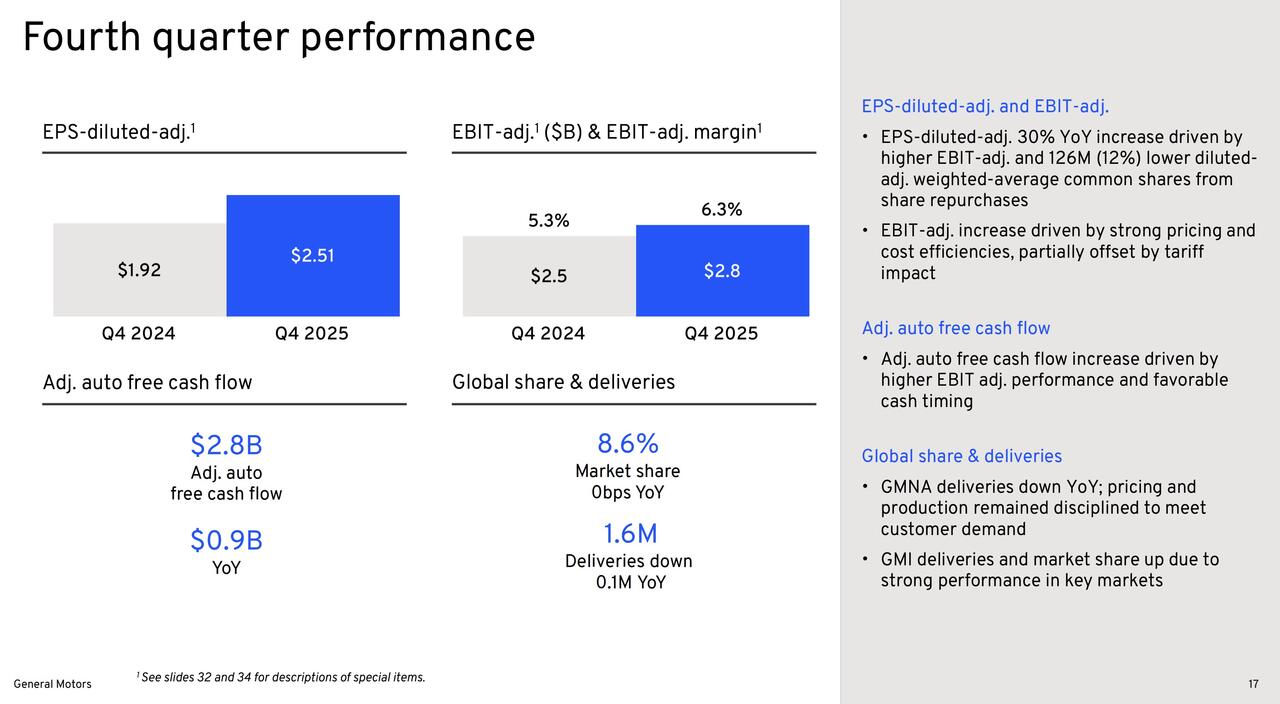
GM reported adjusted earnings per share of $2.51, beating estimates of $2.20, though revenue of $45.29 billion missed expectations.

Shares rose about 7% in early trading.

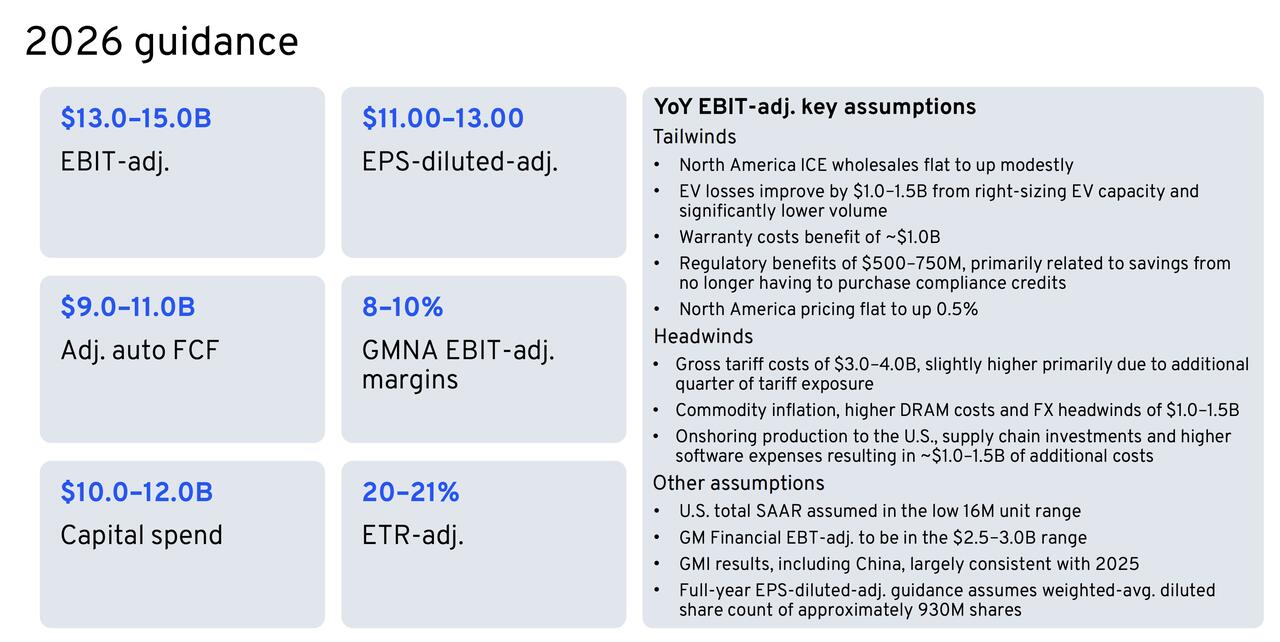
For 2026, GM projects net income of $10.3 billion to $11.7 billion, adjusted EBIT of $13 billion to $15 billion, and earnings per share between $11 and $13. These forecasts reflect continued investment of $10 billion to $12 billion as the company reevaluates its shift toward electric vehicles.

CEO Mary Barra said GM expects North American profit margins of 8% to 10% this year, up from 6.8% in 2025. She added that GM remains “in a strong position to return capital to shareholders.”

In 2025, GM posted net income of $2.7 billion and adjusted EBIT of $12.7 billion, both down sharply from 2024. Revenue fell 1.3% to $185.02 billion.

The company reported a fourth-quarter net loss of $3.3 billion, driven largely by more than $7.2 billion in special charges tied to EV cutbacks, legal issues, restructuring in China, and the shutdown of Cruise.

Barra said GM’s smaller Detroit headquarters is expected to save “hundreds of millions of dollars” each year.

The report says that the new buyback and dividend increase to 18 cents per share continue GM’s effort to reduce shares outstanding, which fell to 904 million at the end of 2025.

North America remained GM’s strongest region, though profits declined 28.1% to $10.45 billion. International operations improved, while losses in China narrowed.

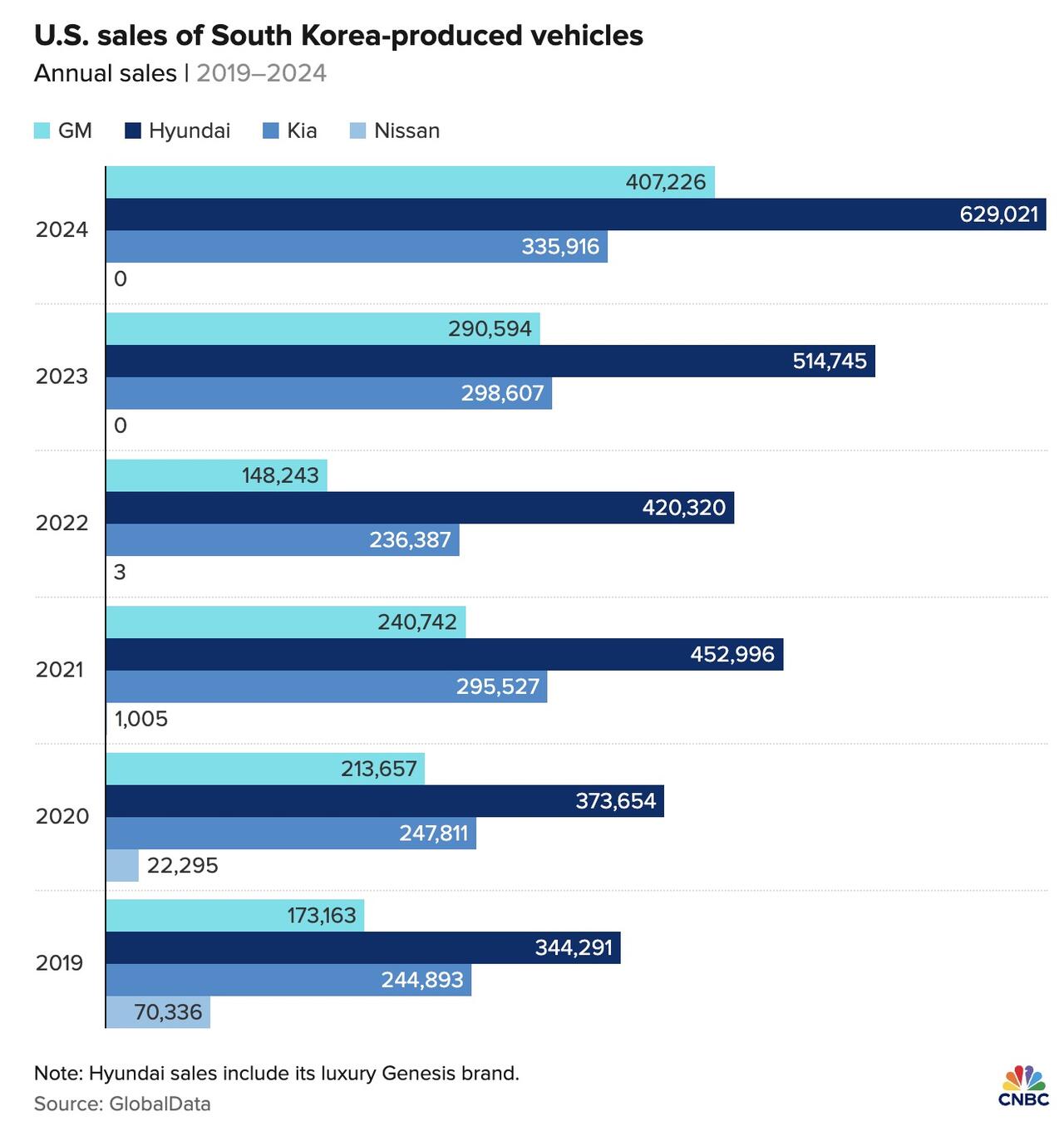
CFO Paul Jacobson said U.S. tariffs cost GM $3.1 billion in 2025. Barra said the company is “hopeful” the U.S. and South Korea will finalize a trade deal with a 15% tariff, warning that higher tariffs could hurt costs.

“We’re really encouraging the countries to get the trade deal done,” Barra said.

GM continues to rely on South Korea for entry-level vehicles such as the Chevrolet Trax and Buick Envista, making trade policy a key issue for its future performance. 

Tyler Durden Tue, 01/27/2026 - 10:20
[syndicated profile] zeroh_feed

Posted by Tyler Durden

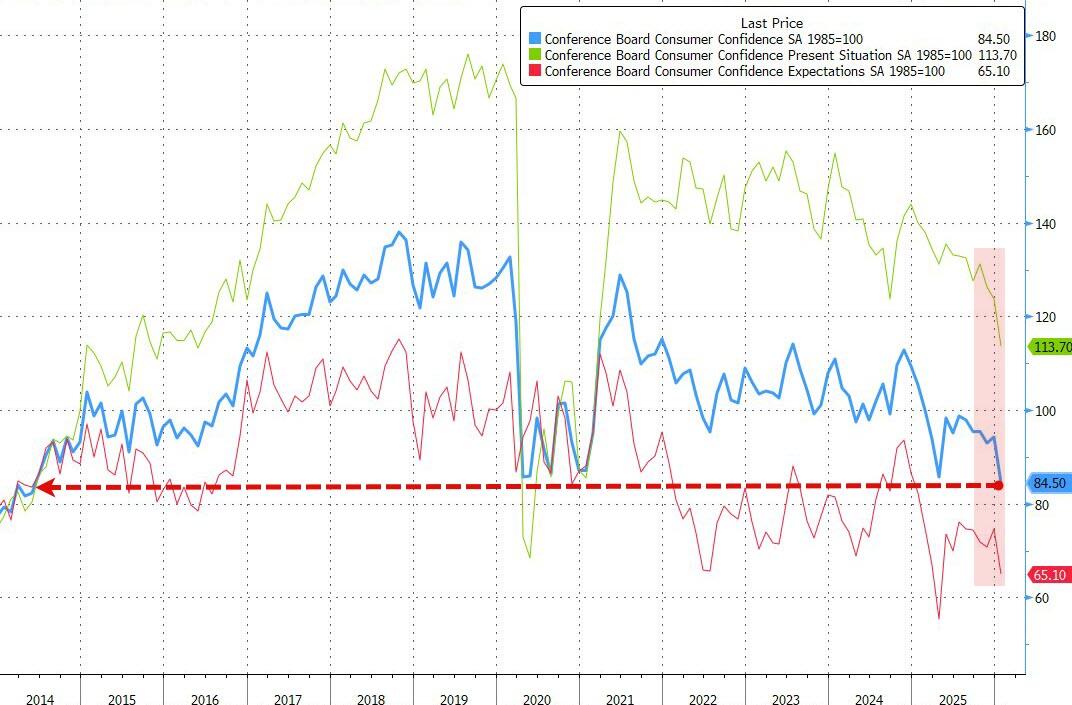
Conference Board Consumer Confidence Crashes To 12 Year Lows

After Boomers and Gen X dragged The Conference Board Confidence measure down to eight month lows to end 2025, expectations were for a rebound to start 2026.

But, reality was far worse with the headline plunging from 94.2 (revised up from 89.1) to 84.5 (well below the 91.0 expected) - the lowest since May 2014.

The Present Situation Index - based on consumers’ assessment of current business and labor market conditions - plummeted by 9.9 points to 113.7 in January (from an upwardly revised 123.6).

The Expectations Index - based on consumers’ short-term outlook for income, business, and labor market conditions - tumbled to 65.1 (from 74.6).

Source: Bloomberg

The Expectations Index has now tracked under 80 for 12 consecutive months, the threshold below which the gauge signals recession ahead.

“Confidence collapsed in January, as consumer concerns about both the present situation and expectations for the future deepened,” said Dana M Peterson, Chief Economist, The Conference Board.

“All five components of the Index deteriorated, driving the overall Index to its lowest level since May 2014 (82.2)—surpassing its COVID-19 pandemic depths.”

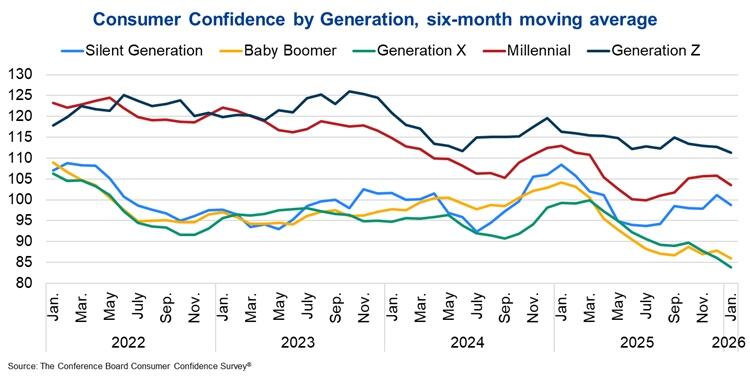
Among demographic groups, confidence on a six-month moving average basis dipped for all age groups in January, although consumers under 35 continued to be more confident than consumers age 35 and older.

Confidence among all generations trended downward in the month, but Gen Z remained the most optimistic of all generations surveyed.

By income, confidence on a six-month moving average basis ticked downward for all brackets, and consumers earning less than $15K remained the least optimistic among all income groups.

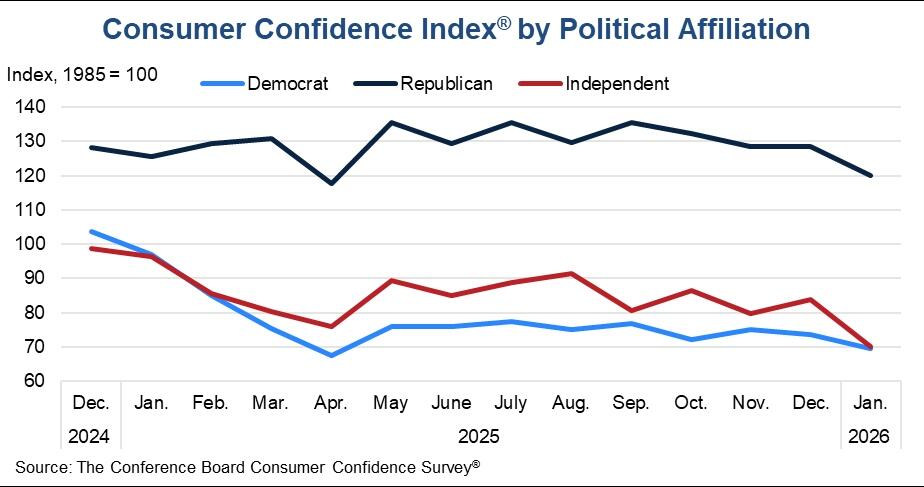
Consumer confidence continued to fade in January among all political affiliations, with the sharpest decline among Independents.

Peterson added:

Consumers’ write-in responses on factors affecting the economy continued to skew towards pessimism. References to prices and inflation, oil and gas prices, and food and grocery prices remained elevated.

Mentions of tariffs and trade, politics, and the labor market also rose in January, and references to health/insurance and war edged higher.”

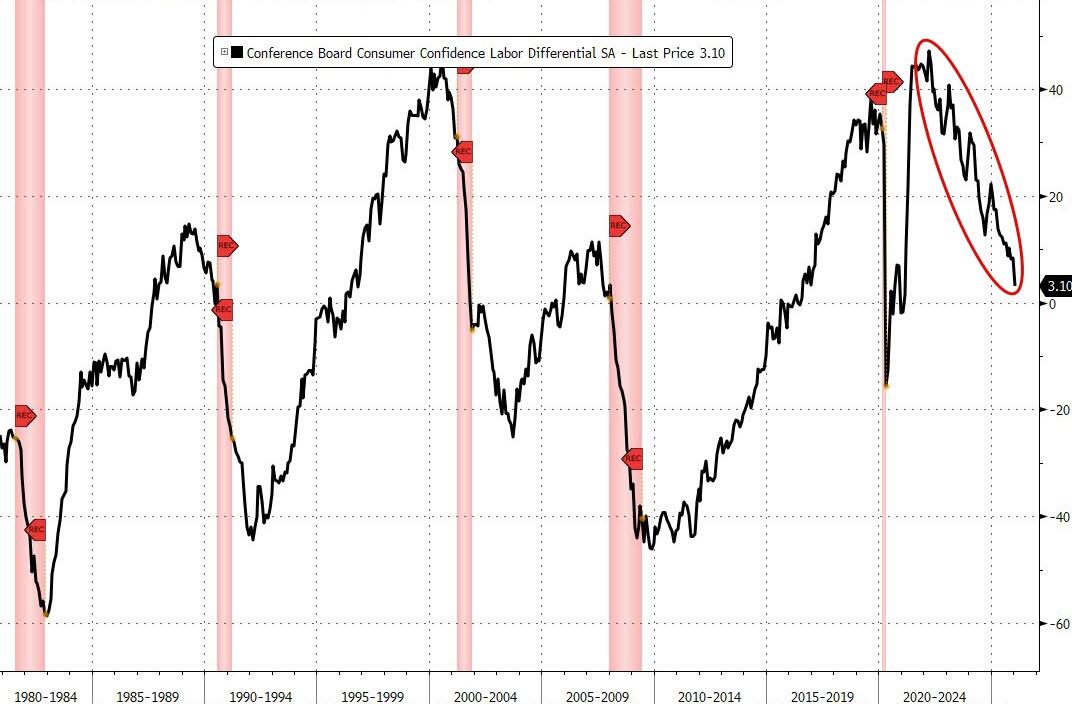
Finally, under the hood, The Conference Board survey shows the trend of a weaker labor market continued to accelerate...

Source: Bloomberg

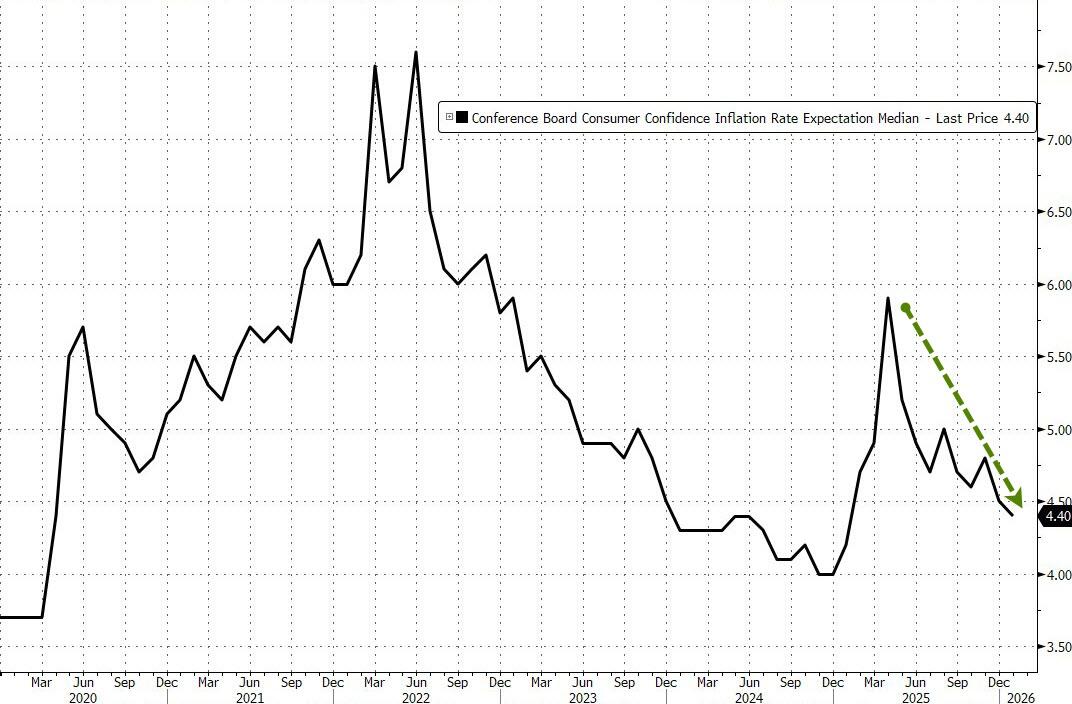
While the labor market languishes, inflation expectations have tumbled (just like they did in the UMich survey)...

Source: Bloomberg

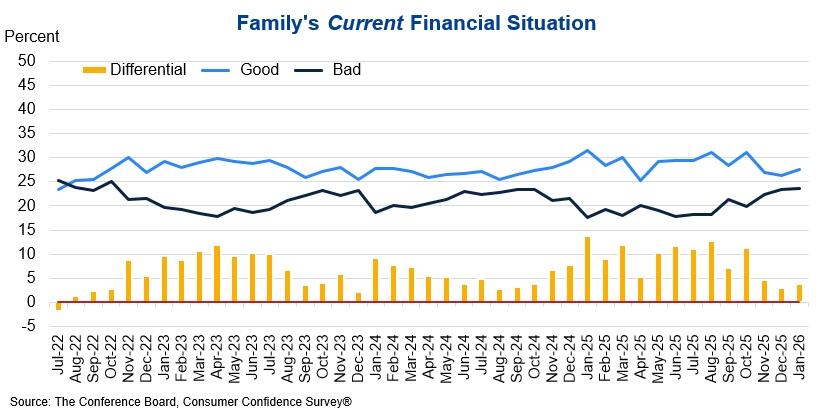
One final (slight) silver lining was that, on net, consumers’ views of their Family’s Current Financial Situation improved slightly in January, after a plunge into negative territory in December was revised upward to reveal a small net positive. 

So, the stock market soars near record highs, GDP is ripping, but consumer sentiment is collapsing?

Tyler Durden Tue, 01/27/2026 - 10:10
[syndicated profile] zeroh_feed

Posted by Tyler Durden

Trump Admin Wins Appeal Of ICE Injunction In Minnesota

Authored by Jonathan Turley,

In a significant victory for the Trump Administration, a panel of the United States Court of Appeals for the Eighth Circuit lifted the injunction of U.S. District Judge Katherin Menendez, who prevented officers from arresting, detaining, pepper-spraying or retaliating against protesters in Minneapolis without probable cause.

In her Jan. 16 decision, Judge Menendez (a Biden appointee and former public defender) ruled in favor of the protesters suing the Department of Homeland Security (DHS) and ICE. She found the plaintiffs were likely to succeed on claims that federal agents violated their First and Fourth Amendment rights.

The Eighth Circuit first flagged how Menendez ignored the fact that the record shows a wide range of conduct raising different conditions for law enforcement:

“We accessed and viewed the same videos the district court did. … What they show is observers and protestors engaging in a wide range of conduct, some of it peaceful but much of it not. They also show federal agents responding in various ways. Even the named plaintiffs’ claims involve different conduct, by different officers, at different times, in different places, in response to different behavior. These differences mean that there are no “questions of law or fact common to the class,” Fed. R. Civ. P. 23(a)(2), that would allow the court to decide all their claims in “one stroke.”

The panel also found Judge Menendez’s order unacceptably vague:

“Second, in addition to being too broad, the injunction is too vague.

…Even the provision that singles out the use of “pepper-spray or similar nonlethal munitions and crowd dispersal tools” requires federal agents to predict what the district court would consider “peaceful and unobstructive protest activity.” The videos underscore how difficult it would be for them to decide who has crossed the line: they show a fast-changing mix of peaceful and obstructive conduct, with many protestors getting in officers’ faces and blocking their vehicles as they conduct their activities, only for some of them to then rejoin the crowd and intermix with others who were merely recording and observing the scene.”

The panel found that Judge Menendez’s order left federal authorities in a dangerous position of not knowing when they could use these crowd control measures: “to the extent the injunction’s breadth and vagueness cause federal agents to hesitate in performing their lawful duties, it threatens to irreparably harm the government and undermine the public interest.”

Notably, Judge Menendez is the same judge reviewing an even more sweeping motion for an injunction to enjoin ICE operations, a filing from Minnesota Attorney General Keith Ellison that I have criticized as constitutionally meritless.

Here is the opinion: Tincher v. Noem

Tyler Durden Tue, 01/27/2026 - 09:45
[syndicated profile] zeroh_feed

Posted by Tyler Durden

From Bad To Worse: UnitedHealth Posts First Annual Revenue Drop In Three Decades

Things have gone from bad to worse for UnitedHealth Group since late Monday.

First, the Trump administration's plan to keep Medicare Advantage rates roughly flat next year (read the report) sent shares tumbling during the after-hours session on Monday evening.

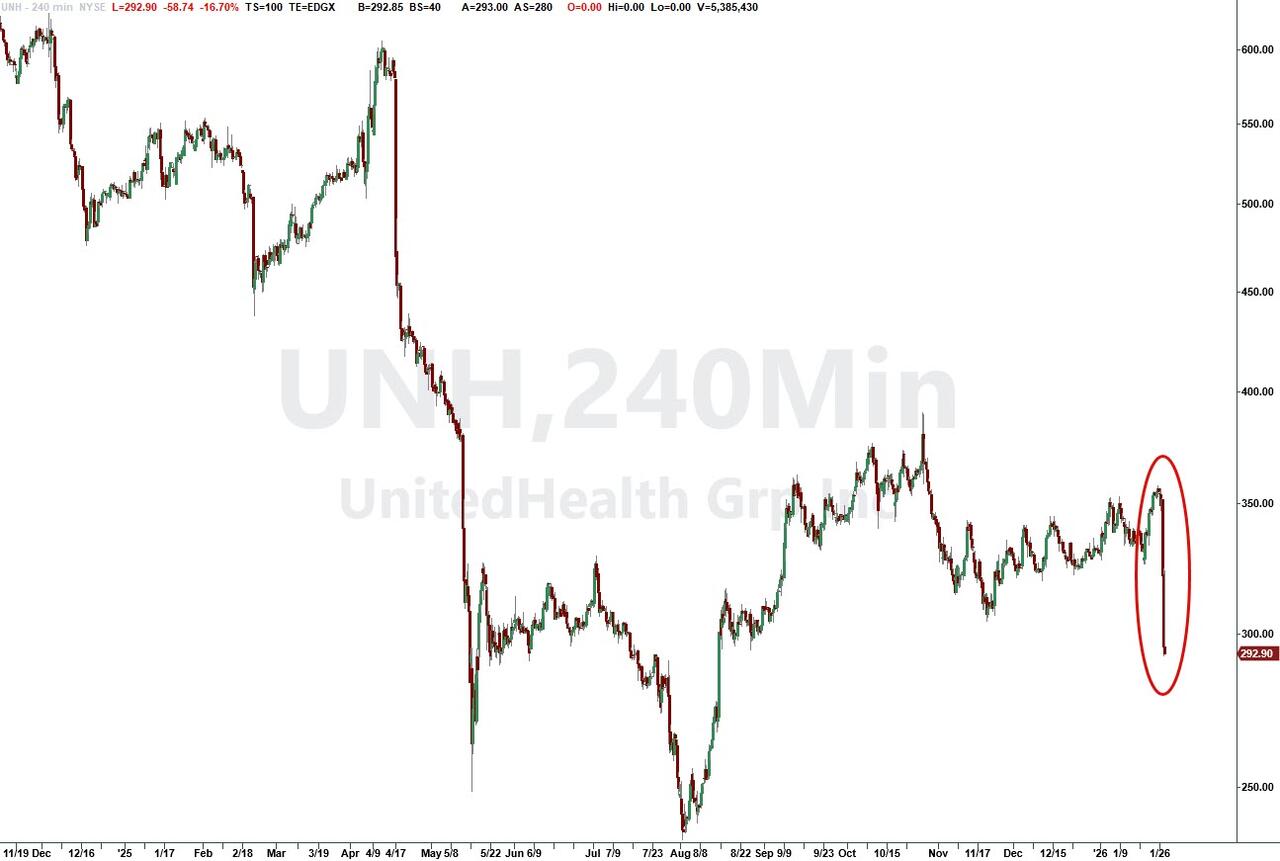
The selloff intensified in premarket trading after the 2026 outlook and quarterly earnings disappointment. The stock plunged as much as 17% ahead of the cash opening in New York.  

UNH shares were already down about 8% heading into the earnings release. Shares extended losses after the insurer forecasted a decline in 2026 revenue, marking its first annual contraction in more than three decades.

Summary of the 2026 Outlook:

  • Adjusted EPS: Guided above $17.75, modestly ahead of the $17.69 Bloomberg Consensus.

  • Revenue: Forecast above $439B, well below the $455B Bloomberg Consensus, signaling top-line pressure.

  • Operating cash flow: Expected above $18B, trailing the $19.7B estimate.

The takeaway from this year's outlook: Profit guidance is slightly better than expected, but the revenue and cash flow outlooks underwhelm analysts' estimates tracked by Bloomberg.

For the fourth quarter, UnitedHealth posted adjusted earnings of $2.11 per share, while revenue climbed 12% year over year to $113.22 billion. Wall Street analysts tracked by Bloomberg had been expecting $2.10 per share on revenue of $113.87 billion.

Summary of the 4Q24 Earnings:

Earnings: Adjusted EPS of $2.11 beat estimates by a cent but fell from $6.81 y/y. Reported EPS was $0.1 vs. $5.98 y/y.

Revenue: $113.22B, up 12% y/y, but missed Bloomberg Consensus of $113.87B.

Segment performance

  • UnitedHealthcare: $87.11B, +18% y/y, above expectations.

  • Optum total: $70.33B, +8% y/y, ahead of estimates.

  • OptumRx: $41.46B, +16% y/y, beat estimates.

  • OptumHealth: $25.54B, -0.5% y/y, roughly in line.

  • OptumInsight: $5.04B, +5.5% y/y, modest beat.

Margins and costs:

  • Medical care ratio: 92.4%, worse than the 92.1% estimate.

  • Operating margin: 0.3%, sharply down from 7.7% y/y and well below the 2.9% estimate.

Enrollment: 49.76M members, below the 51.13M consensus.

The combination of the Trump administration's plan to keep Medicare Advantage rates roughly flat and the first annual revenue drop in three decades disappoints investors, with shares down 17% in premarket trading. This is the largest intraday decline since the May 13, 2025, 17.8% decline.

"We confronted challenges directly and finished 2025 as a much stronger company, giving us the momentum to better serve those who count on us and continue to improve our core performance," UNH CEO Stephen Hemsley wrote in a statement.

Tyler Durden Tue, 01/27/2026 - 09:30
[syndicated profile] zeroh_feed

Posted by Tyler Durden

The Grid Will Hold - Maybe - But The Bill Will Rise

Authored by Terry L. Headley via RealClearEnergy,

Americans are about to pay a lot more for electricity anyway — not because the grid fails, but because of how we now power it.

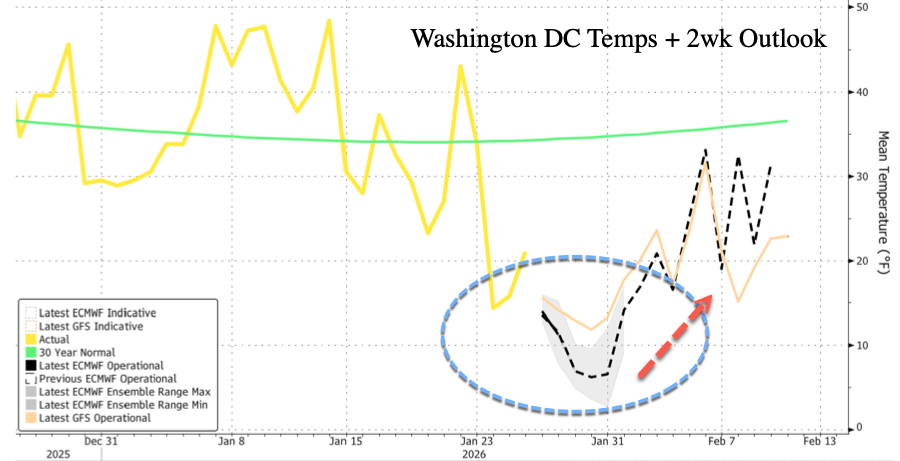
As another deep winter cold snap presses across much of the eastern United States, grid operators are doing what they always do in these moments: watching reserve margins, issuing conservation guidance, leaning on dispatchable generation, and quietly hoping nothing large trips offline at the wrong hour.
If history is a guide, the system will muddle through. It usually does. But survival isn’t the same thing as success. And it’s certainly not the same thing as affordability.

Even if there is no blackout, no emergency load shedding, and no headline-grabbing crisis, this weather event will still deliver a financial shock — one that will show up first in gas markets, then in wholesale power prices, and finally, months later, in the electric bills of households and businesses. That downstream billing impact is not accidental. It is structural. And it tells us far more about the state of the modern grid than any press release ever will.

Yes, the system will probably muddle through through this time. But one day in the not-too-distant future it won’t.

Counting the Cost of High Electric Bills

The modern American electric grid has become adept at avoiding disaster. Operators have more tools than ever: demand response, emergency imports, market signaling, conservation messaging, and sophisticated forecasting. What they do not have — at least not in sufficient quantity — is inexpensive, fuel-secure generation that can run whenever it is needed, regardless of weather.

In winter, the grid’s vulnerability is not generation capacity on paper. It is fuel deliverability in the real world.

Natural gas now sits at the center of that vulnerability. It dominates the marginal price of electricity across large portions of the country, particularly in regions like PJM Interconnection, which spans much of the Mid-Atlantic and Midwest. When gas is abundant and cheap, markets hum along. When it is constrained by cold weather, competing heating demand, pipeline limits, or freeze-offs, prices rise sharply — even if no generator actually fails.

Gas does not have to break to become expensive. It only has to be needed.

That is exactly what happens during prolonged cold snaps. Residential heating takes priority. Storage withdrawals accelerate. Pipelines run near their limits. Power generators bid defensively to secure fuel. The result is predictable: spot gas prices spike at constrained hubs, wholesale electric prices follow, and utilities quietly rack up higher procurement costs.

No blackout. No drama. Just higher bills.

And high electric bills extract a quiet but relentless toll. They are not merely an inconvenience; they function as a regressive tax on households least able to absorb them and a hidden drag on the broader economy.

For families, higher electric bills mean hard tradeoffs. Money spent keeping the lights on is money not spent on groceries, prescriptions, school supplies, or savings. For seniors on fixed incomes, a volatile power bill can force choices between heat and healthcare. For working households, it turns routine weather events into financial stress tests.

For businesses, especially manufacturers and small employers, high electricity costs erode margins, discourage expansion, and quietly kill jobs. Energy-intensive operations either scale back, pass costs along to consumers, or relocate to regions with more stable and affordable power. Over time, this hollowing-out effect weakens local tax bases and strains public services.

For communities, persistently high power costs accelerate decline. Retail districts dim. Investment slows. Population loss follows opportunity. Utility shutoffs rise, charitable assistance is stretched thin, and local governments face growing pressure to subsidize basic services that were once affordable.

And for the grid itself, high bills often signal deeper structural problems—overreliance on volatile fuels, premature retirement of reliable generation, or policy-driven distortions that shift costs from balance sheets to ratepayers. The bill arrives monthly, but the damage accumulates quietly, year after year.

In the end, high electric bills cost more than dollars. They cost stability, competitiveness, and confidence—exactly the things a healthy economy and a secure society require.

The Renewable Mirage in Winter

Renewable advocates often argue that wind and solar will insulate consumers from fossil-fuel volatility. Winter stress events expose the weakness of that claim.

Solar output is minimal during winter peak hours. Wind can help — or not — depending on meteorological luck. Batteries can shave peaks for minutes or a few hours, but they can’t carry a grid through multi-day cold events. When the weather turns hostile, renewables become supplements, not solutions.

That doesn’t mean renewables are useless. It means they are conditional. And conditional resources cannot set the reliability floor of a winter grid.

Yet they increasingly shape the cost structure of the system. Renewable mandates, tax credits, and priority dispatch suppress energy prices when conditions are favorable, discouraging investment in dispatchable generation. But when conditions are unfavorable — when cold sets in and demand spikes — those same policies leave the grid leaning heavily on gas, with fewer alternatives available to keep prices in check.

The irony is hard to ignore: policies sold as a hedge against volatility often amplify it.

The Quiet Role of Coal

This is where coal enters the discussion — not as a political symbol, but as an economic stabilizer.

When coal still dominated the grid, winter pricing behaved differently. Coal plants stored months of fuel on site. They did not compete with residential heating for delivery. They did not depend on pipeline pressure or wellhead performance. When cold arrived, they simply ran.

That mattered.

Coal-heavy systems were not immune to outages or price swings, but they were insulated from the kind of fuel-driven volatility that now defines winter power markets. Coal did not set the marginal price every hour, but it capped how high that price could go. It acted as ballast — heavy, unglamorous, and stabilizing.

Consider the role played by plants like John E. Amos Power Plant in West Virginia. Facilities like this are not interchangeable widgets. They anchor voltage, reduce transmission stress, and provide firm megawatts precisely when they are most valuable. When they run, they suppress scarcity pricing across wide swaths of the grid. When they retire, that suppression disappears — and consumers pay the difference.

If Coal Still Dominated the Grid, This Cold Snap Would Barely Register

It is worth asking a simple, uncomfortable question: If coal still dominated the electric grid the way it once did, would this cold snap even matter?

From a consumer perspective, the answer is largely no.

In a coal-dominated system, winter cold was an operational issue, not a pricing crisis. Load went up, coal units ran harder, operators adjusted dispatch, and the system absorbed the stress. What did not happen — at least not routinely — were sharp fuel price spikes, emergency conservation messaging, or springtime bill surprises blamed on “market conditions.”

The reason was structural.

Coal plants carried weeks — sometimes months — of fuel on site. That fuel was already purchased, already delivered, and already insulated from real-time weather events. Coal did not compete with residential heating demand. It did not depend on pipeline pressure, compressor stations, or wellhead performance. When the temperature dropped, coal plants did not enter a bidding war with homeowners for survival. They simply ran.

That mattered because coal often sat at or near the margin during winter peaks. And when coal is the marginal fuel, prices behave differently. They move modestly. They reflect cost, not fear. They do not explode because of perceived scarcity three states away.

Contrast that with today’s system. Natural gas now sets the price in much of the country. Gas does not need to fail to become expensive; it only needs to be stressed. Cold weather alone is enough. Add pipeline congestion, freeze-offs, or even the risk of nonperformance, and markets immediately inject a scarcity premium. Wholesale electric prices spike — even if every generator shows up and no emergency is declared.

That volatility then works its way downstream. Utilities absorb higher procurement costs. Fuel adjustment clauses kick in months later. Consumers see higher electric bills long after the weather has passed and are told, vaguely, that it was “because of winter.”

Under a coal-dominated grid, that chain reaction was muted or absent. Gas prices might still rise for home heating, but electricity did not compound the pain. Households were not hit twice — once for gas, and again for gas-driven power prices. Industrial customers did not face the same level of real-time exposure. Regulators were not forced to explain why nothing went wrong yet bills still went up.

None of this means coal eliminated winter stress. It did something more valuable: it absorbed it. Coal acted as ballast — heavy, unfashionable, and quietly stabilizing. By removing that ballast without replacing its function, we did not make the grid more fragile in obvious ways. We made it more expensive in subtle, recurring ones.

That is why today’s cold snap will show up on electric bills even if the grid performs flawlessly. And that is why, when coal still dominated, it would have passed with little more than a footnote in an operator’s log.

The lights stayed on then, too.

The difference is that the bill did not quietly grow teeth afterward.

How the Bill Really Shows Up

Consumers rarely connect winter reliability events to their electric bills, because the impact is delayed and obscured.

Here is how it actually works:

  1. Renewables go MIA.
  2. Cold weather tightens reserves
  3. Gas prices spike at regional hubs
  4. Wholesale power prices rise during peak hours
  5. Utilities absorb higher procurement costs
  6. Fuel adjustment clauses catch up months later

By spring, customers open their bills and wonder why rates are higher, even though “nothing happened.” Utilities point to weather. Regulators nod. The underlying structural cause goes largely unexamined.

Industrial customers feel it immediately through real-time pricing and demand charges. Residential customers feel it later, but more painfully, as higher energy bills stack on top of already elevated heating costs.

This is not a one-off phenomenon. It is now a recurring feature of winter.

We Chose This…

None of this is accidental. We made policy choices that traded fuel security for market efficiency, and market efficiency for political aesthetics. We shifted the grid toward just-in-time fuel delivery. We retired on-site fuel without replacing its stabilizing function. We assumed markets would solve problems that are, at their core, physical.

Markets are excellent at pricing scarcity. They are less effective at preventing it.

The result is a grid that survives winter stress events — but at a higher and more volatile cost. We have optimized for avoiding blackouts, not for protecting consumers from price shocks.

The Bottom Line

The grid will likely get through this winter storm. Operators are competent. Procedures are in place. The system will bend, not break.

But bending has a price.

Renewables will be MIA. Gas prices will rise. Wholesale electric prices will spike. Retail bills will follow. And once again, consumers will pay for a system that values politics over reliability.

Coal’s continued presence on the grid does not eliminate these costs — but its absence guarantees they will be higher.

If we want affordable electricity in winter, we must stop designing a grid that depends on perfect conditions to keep prices low.

And the bill always comes due.

Tyler Durden Tue, 01/27/2026 - 09:15
[syndicated profile] zeroh_feed

Posted by Tyler Durden

US Home Prices Surged In November As Mortgage Rates Tumble

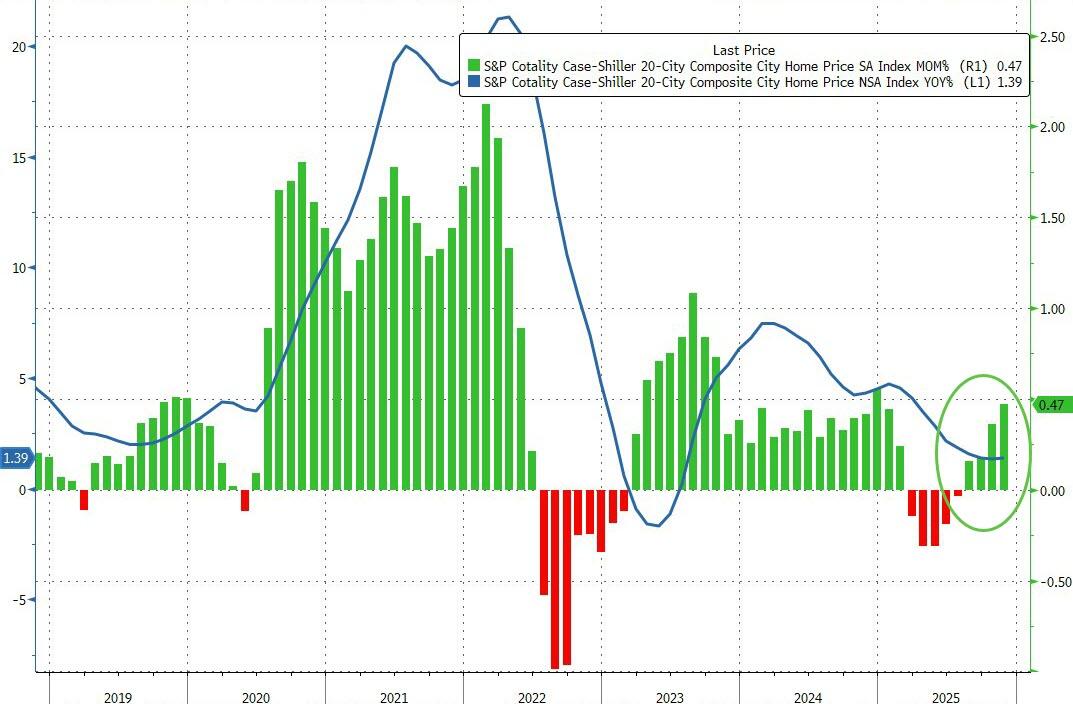
For the fourth straight month, US home prices rose on a MoM basis in November (according to the admittedly lagged and smoothed Case-Shiller data released today). The 0.47% MoM rise is the hottest since Dec 2024

Source: Bloomberg

On a year-over-year basis, there is a very modest inflection higher in the price appreciation (up from +1.32% to +1.39%).

"November's results confirm that the housing market has entered a period of tepid growth," said Nicholas Godec, CFA, CAIA, CIPM, Head of Fixed Income Tradables & Commodities at S&P Dow Jones Indices.

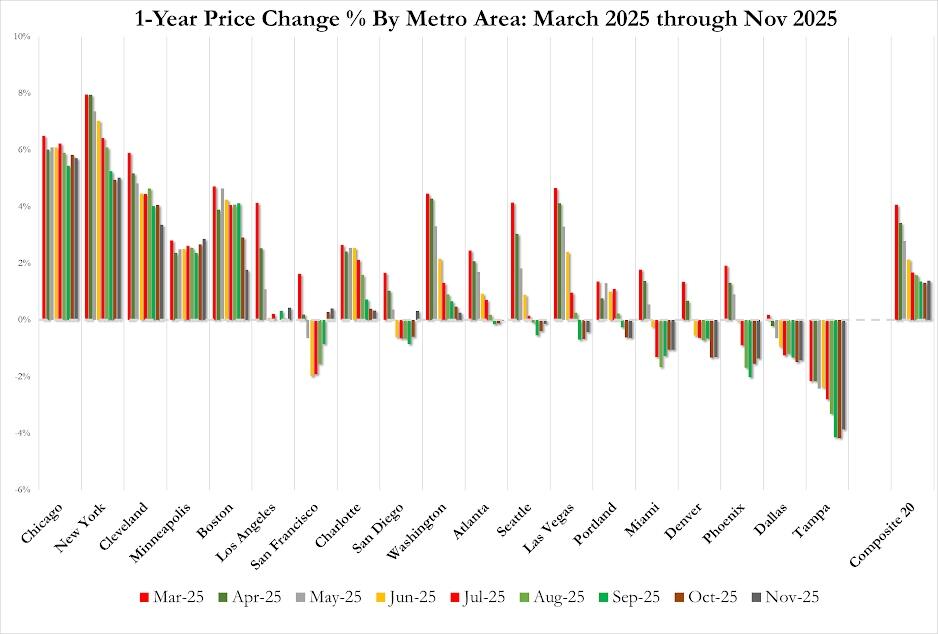
Regional patterns continue to illustrate a stark divergence.

Chicago leads all cities for a second consecutive month with a 5.7% year-over-year price increase, followed by New York at 5.0% and Cleveland at 3.4%.

These historically steady Midwestern and Northeastern markets have maintained respectable gains even as overall conditions cool.

By contrast, Tampa home prices are 3.9% lower than a year ago – the steepest decline among the 20 cities, extending that market's 13-month streak of annual drops.

Other Sun Belt boomtowns remain under pressure as well: Phoenix (-1.4%), Dallas (-1.4%), and Miami (-1.0%) each continue to see year-over-year declines, a dramatic turnaround from their pandemic-era strength.

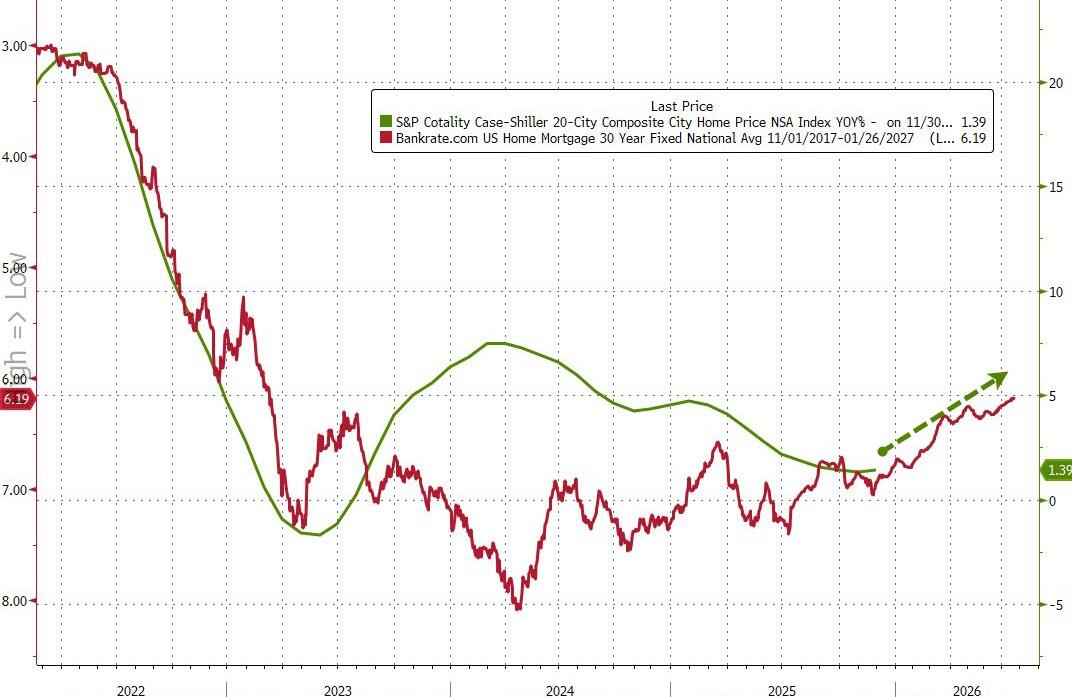
Declining mortgage rates suggest the rebound in aggregate prices could be about to explode...

Source: Bloomberg

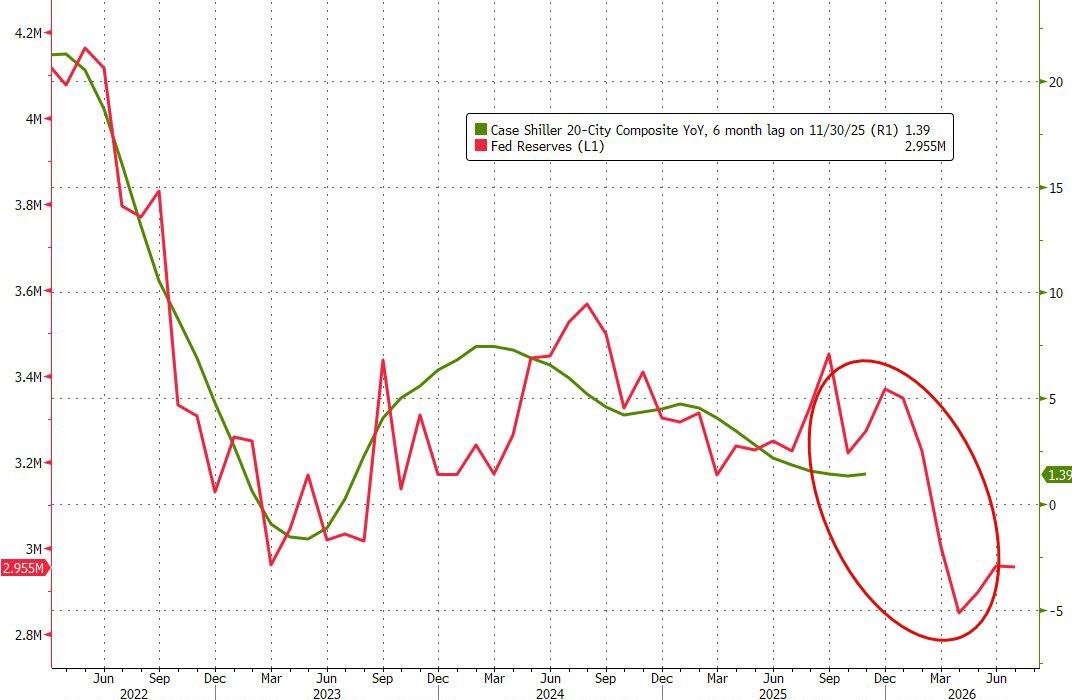
However, home price appreciation does seem to track very closely with bank reserves at The Fed (6mo lag), which implies prices are going continue to lag for the next few months...

Source: Bloomberg

Still, November's data is not exactly what President Trump is looking for from 'lower rates' helping his 'affordability' message.

Tyler Durden Tue, 01/27/2026 - 09:05

(no subject)

Jan. 27th, 2026 10:00 am
budovskiy: (Default)
[personal profile] budovskiy
Богота 2026, Моменты жизни

Безборщевой сейшн номер 16.

Качу прокачали

Jan. 27th, 2026 04:45 pm
vijna: (Default)
[personal profile] vijna
Генеральний штаб

photo_2026-01-27_15-38-10
⚡️Уражено об'єкт ППО ворога

⚡️💥В рамках зниження наступального потенціалу російського агресора у ніч на 27 січня підрозділи Сил оборони України уразили зенітний ракетний комплекс “Тор-М2” поблизу селища Кача на тимчасово окупованій території українського Криму.

Слава Україні! 🇺🇦 🇺🇦 🇺🇦


vijna: (Default)
[personal profile] vijna
👀БПЛА Протягом 4-ох днів (із 23.01 по 27.01.2026) ворог проводив розвідку енергетичних та не тільки об'єктів України.

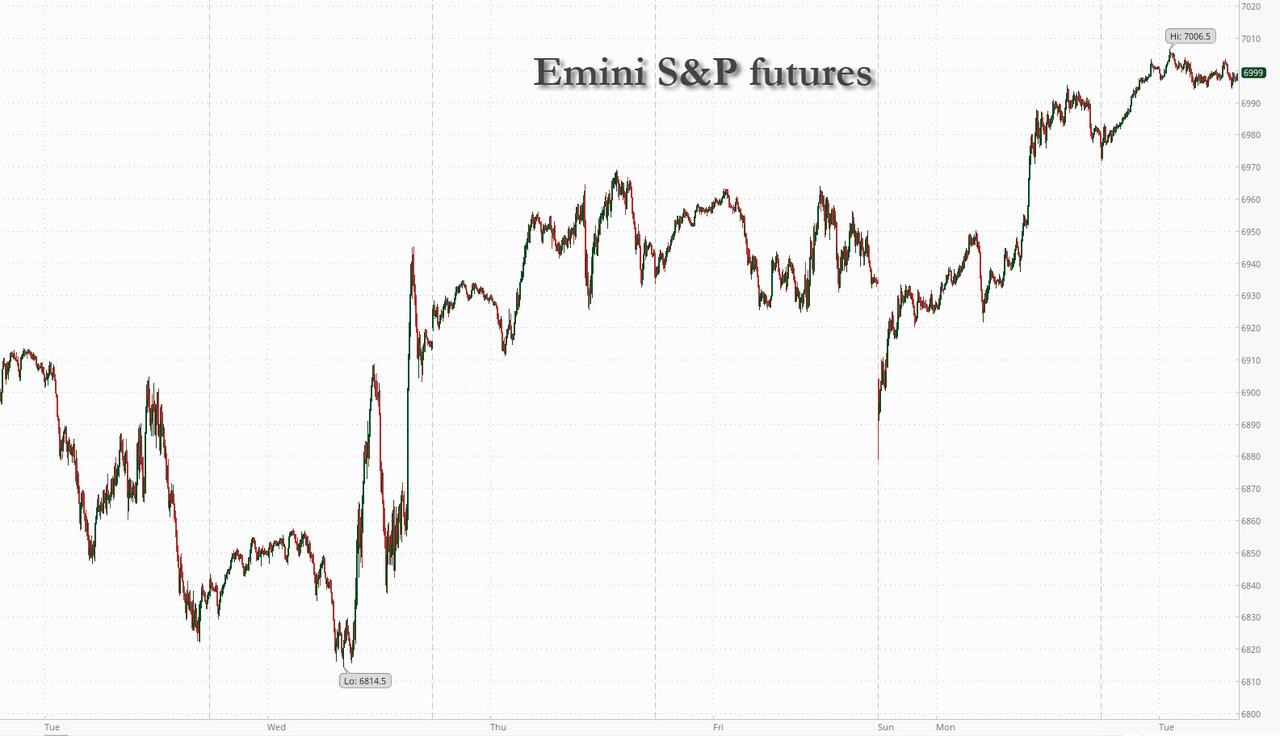
photo_2026-01-27_14-24-37

❗️ Для цього, ворог залучає безпілотники із системами "Starlink". Відомо про модель безпілотника — "БМ-35".

© | [profile] monitoringwar (https://t.me/monitoringwar/23136)


photo_2026-01-27_17-15-31
richana: (Default)
[personal profile] richana
(писано 27.01.2026)
По сумме обстоятельств мне в ЖЖ и на Дриме пока может быть сложно даже читать ленту. Сорри.

Помахивание хвостом будет происходить здесь:  https://t.me/Beacon_Dragons
(Маячок Драконы. Проблесковые проявления признаков жизни.)

 
[syndicated profile] zeroh_feed

Posted by Tyler Durden

Futures Rise Ahead Of Tech Earnings As Gold, Silver Resume Surge

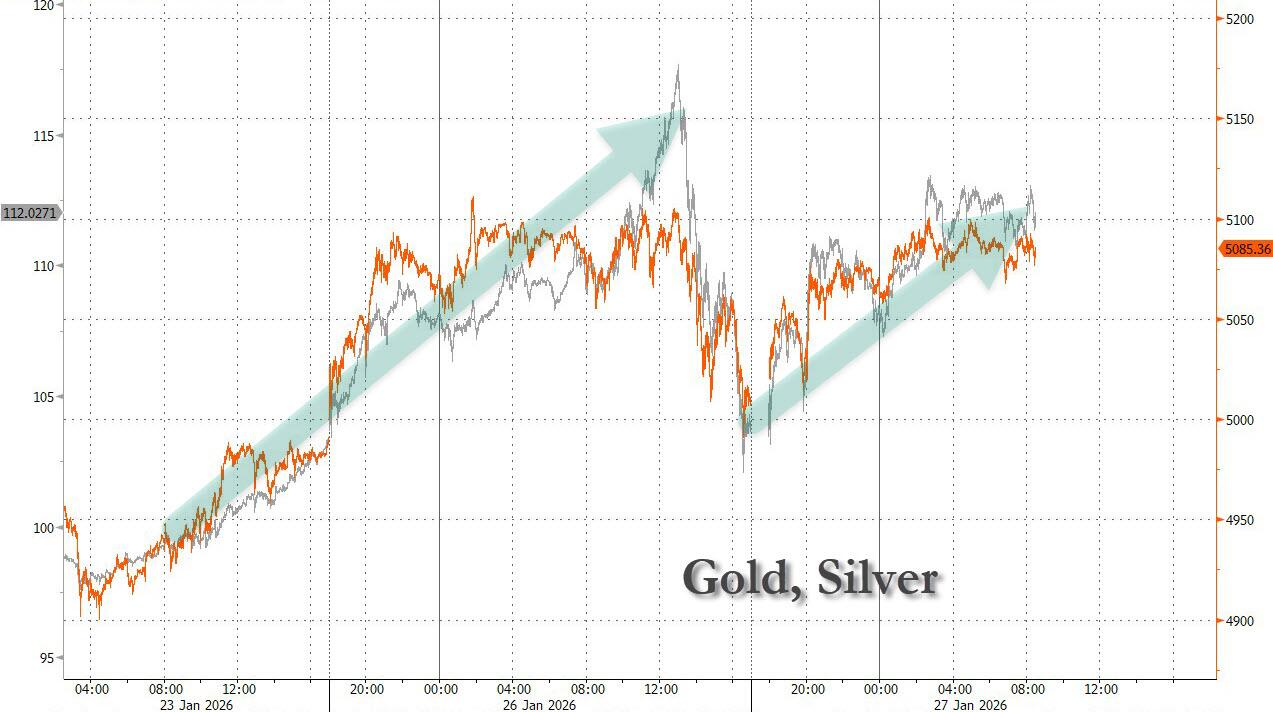
US futures are higher, led by Tech, and approaching record levels from earlier this month as geopolitical and headline risk subsides while the market focuses on looming Mag 7 earnings and Wednesday's Fed decision is expected to be a non-event. Equities are poised for another attempt at 7k. As of 8:00am ET, S&P futures are up 0.2% and set for a fifth day of gains; Nasdaq futures lead gains, up 0.6% with all Mag7 members higher while Healthcare stocks hammered on headlines related to Medicare pricing. Micron jumped 5% in premarket trading on plans to expand its memory-chip capacity. Big tech has started to wake up, with Apple having its best day in three months yesterday and Meta also strong. Both are due to report later this week. So far, the earnings season has been good but not great, according to strategists at BofA. The dollar hit the lowest level since March 2022, while the yen fluctuated as jitters over intervention lingered, before rising to session highs. The yield curve is twisting steeper as JGB-induced vol subsides; In commodities, precious metals continue to move vertically with gold +1.5% and silver +8%, though PGMs are being sold. Today’s macro focus is on the weekly ADP print, home price data, Consumer Confidence, and regional Fed activity indicators.

In premarket trading, Mag 7 stocks are all higher (Microsoft +0.6%, Apple +1.2%, Tesla +0.4%, Nvidia +0.4%, Alphabet +1.1%, Amazon +0.5%, Meta +0.3%).

  • Health insurers including Humana (HUM), UnitedHealth (UNH) and CVS (CVS) slide after the US proposed holding payments to private
  • Medicare plans flat next year. Analyst note that investors are disappointed as they expected mid-single digit-percentage rises. Humana -15%, UnitedHealth -16%, CVS -13%.
  • UnitedHealth also forecast a decline in 2026 revenue, the first annual contraction in more than three decades
  • Agilysys Inc. (AGYS) falls 12% after the hospitality software firm posted fiscal third quarter adjusted earnings per share that fell short of expectations.
  • American Airlines Group Inc. (AAL) rises 3% after reporting fourth-quarter results.
  • CoreWeave (CRWV) gains 4%, set to extend Monday’s 5.7% rally, after Nvidia invested an additional $2 billion in the cloud computing firm. Following the latest investment announcement, Deutsche Bank raised the recommendation on the stock to buy.
  • General Motors Co. (GM) climbs 4% as the company expects profits to grow as much as $2 billion this year and plans to return more of that to shareholders with a higher dividend and buybacks.
  • JetBlue Airways Corp. (JBLU) falls 3% after reporting a wider loss than expected last quarter, highlighting challenges in its strategy to win over higher-paying customers.
  • Northrop Grumman (NOC) slips 1% after the military contractor gave a forecast for full-year adjusted earnings per share below what analysts had expected.
  • Redwire Corp. (RDW) climbs 15% after being awarded a contract for the Missile Defense Agency Scalable Homeland Innovative Enterprise Layered Defense contract.
  • RTX Corp. (RTX) gains 3% after the maker of aircraft engines and missiles reported fourth-quarter adjusted earnings per share above what analysts expected.
  • Sanmina (SANM) falls 8% after the electronics manufacturing services provider gave a revenue outlook for the second quarter that fell short of the consensus estimate.
  • United Parcel Service Inc. (UPS) gains 3% as the courier forecast full-year sales above Wall Street’s expectations as it forges ahead with plans to cut less-profitable package volume out of its network.

Even as stocks are set to make new record highs, there are still numerous reasons to be cautious: Trump and Senate Democrats are hurtling toward another government shutdown, while North Korea fired what appeared to be ballistic missiles off its east coast days after the US released a new defense strategy for the region. While the Greenland drama has died down, there are still some tariff headlines. The EU and India concluded a free-trade agreement after almost two decades of negotiations, part of an effort to deepen economic ties amid Trump’s aggressive trade policies. And Trump threatened to hike tariffs on South Korea to 25%.

Citigroup said that short-covering dominated the latest weekly US large-cap futures flows, while new long risk was added to the Russell 2000. Goldman Sachs strategists, meanwhile, said that a proprietary measure of risk appetite hit the highest level since 2021 last week despite elevated policy and geopolitical uncertainty.

“In the US, while very elevated valuations and the dollar weakness make us more cautious than in Europe, there’s possibly still one or two interest-rate cuts lined up for this year,” said Laurent Chaudeurge, an investment committee member at BDL Capital Management in Paris. “Investors are still chasing the AI trade, and at the moment this is done through semiconductors.”

Precious metals rallied again after gold and silver erased much of their advance in the previous session, with bullion trading near $5,080 an ounce. 

“Gold prices could potentially exceed $7,000 by the end of the year,” said Frederique Carrier, head of investment strategy for RBC Wealth Management in the British Isles and Asia. “The main drivers that were there last year — trade tensions, geopolitical instabilities — are still very much there.”

In earnings, of the 69 S&P 500 companies to have reported so far this earnings season, about 77% have beaten analysts’ forecasts, while nearly 15% have missed. American Airlines, Boeing, General Motors and UPS are among companies scheduled to report before the market open. Texas Instruments is among those due after the close.

In Europe, the Stoxx 600 is up 0.4%, with banks and insurance names leading gains after India and the European Union reached a free trade agreement, with a raft of upbeat earnings also lifting sentiment. Banks and telecoms outperform, while miners and carmakers are the biggest laggards. Here are the biggest movers Tuesday:

  • Puma shares rise as much as 21%, before quickly paring gains, after China’s Anta Sports Products agreed to buy a ~29% stake for €1.5 billion, becoming the biggest shareholder in the German company
  • Siegfried shares rise as much as 15%, the most in over three years, after the contract development and manufacturing organization serving the pharmaceutical industry bought two new sites in the US and one in Australia
  • HSBC shares gain as much as 3.1% in London, to the highest on record, taking the bank’s market capitalization above $300 billion for the first time, as Citigroup (buy) lifts its price target
  • Comet shares rise as much as 7.7% to the highest since October 2024 after ZKB said the Swiss technology firm’s share price doesn’t reflect the benefits it will likely see from the upcoming investment cycle in memory chips
  • HMS Networks surges as much as 14% after releasing its fourth-quarter results, which DNB Carnegie says came in “better-than-feared”
  • Spirax rises as much as 3.7% after analysts at Barclays raised their price target on the maker of pumps and steam management systems. Analysts say the stock has lagged the broader capital goods sector and is now trading at a discount
  • Getinge shares drop as much as 7.2%, the most in more than six months, after the Swedish health-care equipment firm reported weaker-than-expected sales and earnings for the fourth quarter
  • Amplifon shares drop as much as 3.7%, second-worst performer in the Stoxx 600 Health Care Index on Tuesday morning, after Kepler Cheuvreux cut its earning estimates for the hearing-aid retailer and decreased its price target
  • Demant shares slip as much as 3.4%, among the worst performers in the Stoxx 600 Health Care Index on Tuesday morning, after Bank of America decreased its price target on the stock to the lowest among analysts tracked by Bloomberg
  • Capgemini shares fall as much as 3.3%, with traders citing a TV report that highlighted a contract between the IT group and the US’s Immigration and Customs Enforcement
  • Aker BP shares fall as much as 3.2% after Danske Bank cut its recommendation on the Norwegian oil and gas exploration firm to sell from hold on high valuation and the outlook for commodity prices

Earlier in the session, Asian equities extended gains, lifted by a continued rally in technology stocks in Taiwan and South Korea. The MSCI Asia Pacific Index gained as much as 0.9%, with Samsung, SK Hynix and TSMC offering the biggest boost. South Korea’s Kospi led advances in the region with a nearly 3% gain, as investors bought the dip spurred by President Donald Trump’s latest tariff threat. Markets were mostly in the green, with benchmarks in Hong Kong, Singapore, Malaysia and Thailand rising more than 1%. Traders are awaiting mega-cap tech earnings, which will shape expectations for the sustainability of the AI-driven rally. The Federal Reserve’s rate decision on Wednesday will also hold sway over rate-sensitive stocks.

In FX,the Bloomberg Dollar Spot Index drops to the lowest level since March 2022 as the greenback loses ground against almost all its G-10 peers. USD/JPY is down 0.6% near 153.35 after another bout of choppy price action. The pair dropped ~130 pips in relatively short order before recovering, a move that looked similar to price action observed during the European morning session on Friday. There did not appear to be a obvious catalyst for the move.

In rates, treasuries dip following limited price action during Asia session and London morning, similar to European bonds.10-year yields are 4.23%, about 2bps higher on the day and slightly outperforming bunds and gilts in the sector. Focal points of US include consumer confidence data and a 5-year note auction. 

In commodities, spot silver rises 8% and is closing in on Monday’s record high. US crude futures rise 0.5% to around $61 a barrel.

US economic calendar includes weekly ADP employment change (8:15am), November FHFA house price index and S&P Cotality home prices (9am), January Richmond Fed manufacturing index and consumer confidence (10am) and Dallas Fed services activity (10:30am)

Market Snapshot

  • S&P 500 mini +0.3%
  • Nasdaq 100 mini +0.6%
  • Russell 2000 mini +0.4%
  • Stoxx Europe 600 +0.3%
  • DAX little changed, CAC 40 little changed
  • 10-year Treasury yield +1 basis point at 4.22%
  • VIX -0.2 points at 16
  • Bloomberg Dollar Index little changed at 1187.28
  • euro unchanged at $1.188
  • WTI crude +0.3% at $60.83/barrel

Top Overnight News

  • President Trump has received multiple U.S. intelligence reports indicating that the Iranian government’s position is weakening, according to several people familiar with the information. The reports signal that the Iranian government’s hold on power is at its weakest point since the shah was overthrown in the 1979 revolution. WSJ
  • South Korea scrambled on Tuesday to assure the U.S. it remained committed to implementing a trade deal after U.S. President Donald Trump said he would hike tariffs on autos and other imports from its ally, blaming a delay in enacting the pact agreed last year. RTRS
  • India and the European Union said Tuesday they have reached a free-trade agreement that will open a new market for European cars and other products, showing how the world’s middle powers are expanding alliances in response to President Trump’s tariffs. WSJ
  • The Trump administration has indicated to Ukraine that US security guarantees are contingent on Kyiv first agreeing a peace deal that would likely involve ceding the Donbas region to Russia. FT
  • China’s industrial enterprises had their first annual gain in profits since 2021, as producer deflation showed signs of easing in the wake of government efforts to curb excess competition and cut capacity. Profits climbed 5.3% in December from a year earlier, rising for the first time in three months and recovering from a plunge of more than 13% in November. BBG
  • Japan’s bond meltdown sparked speculation that the $1.8 trillion GPIF might shift its portfolio allocation to JGBs while reducing foreign bond holdings, particularly Treasuries. BBG
  • Trump said he will increase the tariff rate on South Korean imports from 15% to 25% unless the South Korean National Assembly approved the trade deal struck back in July. NYT
  • US natural gas fell, with traders taking profits after prices shot up almost 30% on Monday amid freezing temperatures that pushed up heating demand. BBG
  • Republicans and President Trump designed their tax cuts for this moment, creating a refund bonanza that will land in Americans’ bank accounts well ahead of the midterm elections. The annual tax-filing season that opened Monday will produce a cash surge estimated at $100 billion beyond last year’s $329 billion total. WSJ
  • Philippines said they conducted joint military exercises with the US in the South China Sea: Al Arabiya.
  • US ambassador to China Perdue said in Bloomberg TV interview that China and the US completed most agreements made in Busan, South Korea.

Trade/Tariffs

  • US President Trump announces he is "increasing South Korean TARIFFS on Autos, Lumber, Pharma, and all other Reciprocal TARIFFS, from 15% to 25%".
  • South Korea Legislature Trade Committee head said that passages of such trade bills usually take six to seven months.
  • South Korea's ruling party said it aims to pass special act on US trade deal by end of February, according to Yonhap Infomax.
  • South Korean ruling party official said bills to enact US investment have been introduced and will soon be reviewed.
  • South Korean Industry Ministry said Minister is to visit the US soon and meet with Commerce Secretary Lutnick.
  • EU Commission begins 2 set of proceeding on Google under the DMA; Google is designated as a core platform service, requiring interoperability with third-party services.
  • China reportedly signs deals to buy at least 8 cargoes or approximately 520k tonnes of Canadian Canola following PM Carney's visit, according to sources.
  • Chinese Foreign Minister said UK PM Starmer will visit China between January 28-31st.
  • European Commission President von der Leyen said EU and India finalised a trade deal, and called it "the mother of all deals".
  • Japan and the US are reportedly to announce several projects in a first batch under the USD 550bln scheme.

A more detailed look at global markets courtesy of Newsquawk

APAC stocks were mostly higher following on from the rebound on Wall Street, but with some of the gains capped ahead of key events and big tech earnings stateside, while participants also digested Trump's latest tariff salvo against South Korea. ASX 200 rallied on return from the long weekend, with risk appetite also facilitated by M&A-related headlines and improved business sentiment. Nikkei 225 gained despite the initial indecision following recent currency moves and after Services PPI cooled but remained above the BoJ's price  target. KOSPI sold off at the open following US President Trump's announcement to raise tariffs on South Korean autos, lumber, pharma, and all other reciprocal tariffs to 25% from 15% due to its legislature not yet enacting the US-Korea trade deal. However, the index then clawed back its losses and more, with the TACO trade likely in play and with South Korean officials attempting to appease Trump. Hang Seng and Shanghai Comp traded somewhat mixed with firm gains in Hong Kong led by Zijin Mining, which is to buy Canada's Allied Gold for USD 4bln, while the mainland index lagged despite an acceleration in Chinese Industrial Profits and the PBoC's liquidity efforts.

Top Asian News

  • China is to roll out policy document on boosting jobs amid AI impact, according to Xinhua. China will roll out policies to support employment amid AI shift and will boost support for employment among key groups.

European bourses (STOXX 600 +0.3%) are broadly in the green this morning, following a similar theme seen in the APAC session. The DAX 40 (-0.2%) is mildly pressured whilst the FTSE 100 (+0.4%) outperforms slightly, benefitting from strength in Banking names. European sectors are mixed; Banks lead followed closely by Insurance names whilst Basic Resources lags given the broader losses seen in underlying metal prices. In terms of key movers, Puma (+4%) opened higher by 20%, but has since pared much of that move - Jefferies highlighted that ANTA may find it hard to boost Puma's brand in China, given it already has high presence in the region.

Top European News

  • China's Industry Ministry announces that they have renewed the cooperation MOU regarding green maritime tech and shipbuilding with Denmark.
  • India to sign a security and defence partnership with EU today in addition to advancing the free trade agreement at the 16th India-EU Summit, according to The Print.
  • UK government plans to tighten scrutiny of Chinese influence in the UK, with PM Starmer seeking to bolster the registration scheme while still deepening Sino-British ties, according to FT.

FX

  • G10s were initially broadly lower against the USD, but following recent JPY strength, G10s are now broadly higher. JPY leads the pile (vs initially underperforming), whilst the NZD and CAD hold around the unchanged mark. EUR/USD is mildly lower, and ultimately within a narrow 1.1850-1.1899 range. Earlier, the EU and India announced an FTA, which cut circa EUR 4bln of tariffs on the bloc’s exports.
  • Delving into USD/JPY, the pair fell from 154.49 to a session low of 153.16 within a few minutes, but has since pared back towards 153.90. This drove the pair below the prior day’s low, and also below its 100 DMA at 153.61. A move that also weighed on the Dollar index, which fell from 97.10 to a session low of 96.90. Nothing fresh behind that move, with participants ultimately mindful of potential intervention risks, or further rate checks being carried out by the US and/or Japan. Note, the JPY move occurred alongside reports of an explosion near Iran's Parchin site, a development that potentially influenced the JPY; however, the lack of follow-through to other assets, particularly crude, diminishes this narrative.
  • DXY is flat this morning and trades within a 96.90 to 97.28 range, and currently holding within the prior day’s ranges. On the trade front, US President Trump said South Korea had delayed its trade agreement with the US and imposed a 25% tariffs on various Korean sectors – the Korean Industry Minister is to visit the US, and aims to pass a special act on the deal by end-February. The Korean Won was initially pressured at the reopen of trading, but has pared about half of the move. Back to the US, markets await ADP Weekly Average figures, Richmond Fed and Consumer Confidence. Participants also count down to the FOMC tomorrow. Barring any surprises in the data, the DXY may find itself relatively rangebound into the confab.

Fixed Income

  • A modestly bearish start for fixed income. Action driven by the mostly constructive risk tone, though there are some pockets of weakness in Equities.
  • USTs a tick or two softer in a 111-23 to 111-26+ band, within Monday's 111-22+ to 111-30 parameters. Aside from supply, which follows a solid 2yr auction last night, the US docket is headlined by ADP.
  • Bunds are also lower, with magnitudes slightly larger to losses of 15 ticks at most. No follow through to Bunds or EGBs generally from the morning's German and Italian supply, taps that were unremarkable but robust enough.
  • Gilts gapped lower by 15 ticks, acknowledging the pressure seen in peers overnight from the constructive risk tone. Since, the benchmark has stabilised slightly off lows and trades broadly in line with European benchmarks. The morning's 2033 UK auction was well received, with a b/c above the 3x mark, though this did not spur any move in Gilts.
  • Italy sold EUR 3bln vs exp. EUR 2.5–3bln 2.20% 2028 BTP & EUR 2bln vs exp. EUR 1.5–2bln 1.10% 2031, 2.55% 2056 BTPei.
  • UK sold GBP 3.25bln 4.125% 2033 Gilt: b/c 3.18x (prev. 3.04x), average yield 4.296% (prev. 4.191%), tail 0.2bps (prev. 0.3bps).
  • Germany sells EUR 4.633bln vs exp. EUR 6bln 2.10% 2028 Schatz: b/c 2.1x, average yield 2.14%, retention 22.8%.
  • Germany opens books to sell EUR-denominated 20-year Bund via syndicate; guidance seen +3bps to DBR.
  • EIB to sell EUR-denominated 5-year bonds, guidance seen +9bps vs mid-swaps.
  • Australia sold AUD 1bln 1.50% June 2031 bonds, b/c 3.46, avg. yield 4.4382%.

Commodities

  • Crude benchmarks softened in the earlier hours of the Asia-Pac session. WTI futures fell from USD 60.85/bbl to a trough of USD 60.17/bbl following the report, but have since rebounded slightly as the European session gets underway, but remains just shy of the USD 61/bbl figure. It was recently reported that explosions were heard near Iran's Parchin nuclear site, but no damage was reported. Some reports suggest it could have been a routine missile test – no move in crude benchmarks on the initial or subsequent reports.
  • Nat Gas prices remain elevated, Dutch TTF holds above EUR 40/MWh while Henry Hub futures hover near USD 7/MMBtu, as the Arctic storm provides a short-term shock to gas production.
  • Precious metals continue to rise, despite selling off late in the US session, which was seemingly led by profit-taking in silver. Spot XAU found support at USD 5,000/oz and is currently trading just shy of USD 5,100/oz. Spot silver returns above USD 112/oz after a USD 15/oz selloff from its ATH of USD 117.70/oz on Monday.
  • 3M LME Copper re-opened lower, as it reacted from the selloff in the precious metals space, but found support at USD 13k/t before oscillating in a USD 13k-13.15k/t band.
  • Explosions have reportedly been heard near Iran's Parchin nuclear site, no damage has been reported - details light, awaiting verification.
  • Largest US power grid PJM Interconnection has issued alerts amid storm bolstering energy demand.
  • Deutsche Bank expects a quarterly peak of USD 13k/t in Q2, with price moderation onwards as production recovers at several major mines. Threat of US tariffs on refined copper should lead to continued metal flows to the US in H1'26. On aluminium, they assume some moderation from current levels in H2 (2026 Avg. of USD 2.9k/t, peak of USD 3.1k/t in Q2).
  • German's Economic Minister said they will move forward with the wind power tenders to expand capacity.
  • Deutsche Bank thinks USD 6,000/oz for spot gold is achievable this year due to a weaker dollar; in alternative scenarios, USD 6,900/oz would be in line with the past 2-year outperformance. An eventual moderation of XAU/XAG ratio may result in higher absolute silver prices.
  • ADNOC Gas (ADNOC) CEO said they're investing more than USD 20bln to increase processing capacity by approximately 30% by 2029.
  • DTEK Power Company said the Russian attack damaged an energy facility in Ukraine's Odesa region.
  • UAE’s ADNOC chief revises forecast and sees oil demand above 100mln barrels per day until 2040.
  • US President Trump is said to be mulling a cap on California state fuel tax and vowed to drive down the state's gas prices, according to NY Post.

Geopolitics: Ukraine

  • DTEK Power Company said the Russian attack damaged an energy facility in Ukraine's Odesa region.
  • Infrastructure facilities in the Lviv region of western Ukraine were hit by a Russian strike, according to the regional governor.
  • US President Trump's administration has signalled to Ukraine that US security guarantees are contingent on Kyiv first agreeing a peace deal that would likely involve ceding the Donbas region to Russia, according to sources cited by FT.

Geopolitics: Middle East

  • Intensive diplomatic efforts are currently underway between Iran and the US across multiple channels, Kann news reported; efforts aimed at reducing the level of "escalation" between parties. However, no significant breakthrough reported at this stage.
  • Explosions have reportedly been heard near Iran's Parchin nuclear site, no damage has been reported - details light, awaiting verification.
  • Palestinian media reported Israeli artillery shelling targeting areas in Khan Yunis in the southern Gaza Strip, according to Sky News Arabia.
  • The Rafah crossing is estimated to be opened on Wednesday or Thursday, Israeli media reported.
  • The explosions heard on the outskirts of Tehran are a routine missile test, Al Hadath reported citing Iranian TV.

Geopolitics: Other

  • South Korea's National Security Office reportedly urges North Korea to immediately stop its launches of ballistic missiles.
  • North Korea reportedly fired several ballistic missiles, according to the South Korea military.
  • North Korean missile appears to have landed outside of Japan's Exclusive Economic Zone (EEZ), according to NTV.
  • Japan's Coast Guard sends second notice that a possible North Korean ballistic missile has already fallen.
  • Projectile believed to be North Korean-fired ballistic missile has already fallen, according to the Japanese Coast Guard.
  • Japanese Coast Guard issues second notice regarding North Korean projectile.
  • North Korea fires projectile towards sea, according to Yonhap; details light.
  • China said US-Philippines patrol in South China Sea undermines regional peace, while China’s military vows to safeguard sovereignty and maritime rights, uphold regional peace amid US-Philippines patrol.
  • US President Trump said he is pleased to report that Venezuela is releasing its political prisoners at a rapid rate, which rate will be increasing over the coming short period of time. Full post: "I am pleased to report that Venezuela is releasing its Political Prisoners at a rapid rate, which rate will be increasing over the coming short period of time. I’d like to thank the leadership of Venezuela for agreeing to this powerful humanitarian gesture! PRESIDENT DONALD J. TRUMP".

US Event Calendar

  • 9:00 am: Nov FHFA House Price Index MoM, est. 0.26%, prior 0.4%
  • 9:00 am: Nov S&P Cotality CS 20-City YoY NSA, est. 1.2%, prior 1.31%
  • 9:00 am: Nov S&P Cotality CS U.S. HPI YoY NSA, est. 1.3%, prior 1.36%
  • 10:00 am: Jan Richmond Fed Manufact. Index, est. -5, prior -7
  • 10:00 am: Jan Conf. Board Consumer Confidence, est. 91, prior 89.1

DB's Jim Reid concludes the overnight wrap

The post-Greenland rally has continued over the last 24 hours, with the S&P 500 (+0.50%) posting a fourth consecutive advance that left the index within half a per cent of its record high. For 2026 standards it was a quiet but solid day for bonds and equities ahead of the FOMC tomorrow and four out of the Mag-7 reporting tomorrow and Thursday. However, we did see some extreme moves in precious metals, with gold prices (+0.43%) closing above $5,000/oz for the first time ever, while silver (+0.57%) gave up almost all of its +14% intra-day gain before rallying again this morning in the Asia session.

That precious metal pullback began shortly after the European close yesterday but it’s proving short-lived, with gold back up +1.23% to $5,070oz as I type, with silver up +5.39% to $109.38/oz. And even though it’s still January, gold had already seen a YTD return of +16% as of yesterday’s close, whilst silver has surged +45% since the start of the year. Silver prices are up over +260% since the start of 2025, although unlike gold they still haven’t exceeded their real terms peak back in 1980. My CoTD yesterday (link here) showed the 235 year history for both gold and silver in real terms. The fascinating thing is that on January 9th this year (ie 2.5 weeks ago) silver in real terms was no higher than it was at the start of 1790! So while I've generally been a precious metal bug in recent years given my belief that fiat money is inherently inflationary, over the medium to longer-term precious metals are unlikely to compete with equities, especially from this starting point. It doesn't mean you shouldn't hold in a diversified portfolio but some realism of future long-term returns should be factored at these levels.

The volatility in precious metals came as the US dollar lost further ground, with the dollar index (-0.55%) closing less than half a percent from the post-2022 lows it reached back in September. In part, that was driven by the Japanese Yen’s strength, which moved up +0.99% against the US Dollar yesterday, making it the strongest-performing G10 currency. That followed the weekend comments from PM Takaichi that the government was prepared to “take all necessary measures to address speculative and highly abnormal movements”. But on top of that, investors also had to grapple with the prospect of a fresh government shutdown this week, which is now considered a 79% probability on Polymarket, not long after the longest-ever government shutdown back in Q4. Those odds did decline a couple of percent age points from earlier yesterday as we saw some de-escalation of the tensions between the White House and local officials over the recent events in Minnesota. Our economists note that a shutdown could delay the big refund cheques about to go out so there are incentives to compromise and avoid any lasting disruption.

Looking at the equity moves in more detail, as mentioned at the top, the S&P 500 (+0.50%) posted a 4th consecutive advance. The NASDAQ (+0.43%) and Mag-7 (+0.46%) saw similar gains, while blue chip names helped a slight outperformance for the Dow Jones (+0.64%). By contrast, the small cap Russell 2000 (-0.36%) lost ground for a second session running. The index is still up +7.16% YTD compared to a +1.53% gain for the S&P 500, having outperformed the S&P for fourteen consecutive sessions at the start of the year prior to Friday.

Those equity gains were bolstered by another batch of stronger-than-expected US data which added to the buoyancy of risk assets there. For instance, the Dallas Fed’s manufacturing activity hit a six-month high of -1.2 in January (vs. -8.5 expected). And the durable goods orders for November were up +5.3% (vs. +4.0% expected). So that cemented the optimistic view around Q4 growth, with the Atlanta Fed’s GDPNow estimate remaining at an annualised pace of +5.4%.

Earlier in Europe, the performance was a bit more subdued by comparison to the US, with the STOXX 600 only up +0.20%. That followed an underwhelming set of data, with the Ifo’s business climate indicator in Germany remaining at 87.6 in January (vs. 88.2 expected). Plus the expectations component unexpectedly fell to an 8-month low of 89.5 (vs. 90.3 expected). So that dampened sentiment a bit, with investors dialling up the probability of an ECB rate cut this year. And in turn, sovereign bonds rallied across Europe, with yields on 10yr bunds (-3.9bps), OATs (-5.8bps) and BTPs (-4.7bps) all falling back. US Treasuries also rallied a bit, with the 10yr yield (-1.3bps) falling to 4.21%.
Elsewhere, the Canadian dollar was the worst performing of the G10 currencies yesterday after Trump’s weekend threat of 100% tariffs against Canada if it strikes a trade deal with China. In response, Canada’s trade minister LeBlanc said he had reassured US Trade Representative Greer that the recent pact with China was a "narrow arrangement”. We saw further tariff headlines just after the US close, as Trump posted that he was raising tariffs on South Korea from 15% to 25% in response to South Korea’s legislature not yet enacting the trade agreement reached last year. So tariff threats remain an active policy tool for the White House, even if last week’s episode over Greenland shows that the resulting tensions can also decline quickly.

Asian equities are mostly higher this morning. The KOSPI (+2.43%) is higher after dipping at the open following the tariff news. However, sentiment improved when South Korea’s presidential office clarified that it had not received prior notification of any tariff increase plans. Additionally, it was noted that Trade Minister Kim Jung-kwan, who is currently in Canada, would travel to Washington for discussions with US Commerce Secretary Howard Lutnick. In other markets, the CSI (+0.34%), Shanghai Composite (+0.25%), the Nikkei (+0.69%), the ASX (+0.92%) and the Hang Seng (+1.01%) are all higher. S&P 500 (+0.28%) and NASDAQ 100 (+0.55%) futures are both higher. Meanwhile, 10yr USTs are +1.6bps higher standing at 4.23% as we go to print.

The Japanese yen (-0.18%) is experiencing a small decline after two days of gains, with 10 and 30yr JGB yields back up +5.3bps and +4.8bps respectively. In terms of data, China’s industrial profits have returned to growth, ending a two-month contraction with a rise of +5.3% year-on-year in December, significantly surpassing expectations of a -13.1% decline.

Looking at the day ahead, US data releases include the Conference Board’s consumer confidence for January and the Richmond Fed’s manufacturing index for January. Otherwise, central bank speakers include the ECB’s Nagel, and earnings releases include Boeing, UnitedHealth, UPS and General Motors.

Tyler Durden Tue, 01/27/2026 - 08:33

Всё

Jan. 27th, 2026 09:05 am
tima: (Default)
[personal profile] tima
тело последнего заложника члена элитного контртеррористического отряда сержанта Рана Гвили в Газе найдено и увезено в Израиль.
tima: (Bruins)
[personal profile] tima
Прошло 32 года с начала проведения зимних Игр, пока страна, наиболее ассоциирующаяся со льдом и снегом, наконец-то не дебютировала на зимних Олимпийских играх семь десятилетий назад в Кортина-д'Ампеццо, когда сборная Советского Союза прибыла туда, во главе с мужской хоккейной командой. СССР доказал, что умеет играть не только в хоккей, выиграв три из четырех соревнований по конькобежному спорту и завоевав семь медалей в лыжных гонках, легко возглавив общий медальный зачет.

Советский Союз оставался на вершине мирового спорта или рядом с ней до тех пор, пока страна не распалась на 15 частей за шесть недель до Игр 1992 года, даже при том, что она была вновь объединена (за исключением стран Прибалтики) для участия в Альбервиле. С тех пор даже отделенная от СССР Россия сама по себе была более чем конкурентоспособной, несмотря на санкции на двух последних Олимпиадах за вопиющее применение допинга.

Но теперь, из-за неспровоцированного и продолжающегося вторжения в Украину, команда отстранена от XXV зимних Олимпийских игр, которые начнутся в Милане и Кортина-д'Ампеццо через 10 дней. В Олимпийском комитете всё уже решено, и на данный момент это конец пути для российской олимпийской команды. По крайней мере на эти Игры.

Отдельным нейтральным спортсменам из России будет разрешено участвовать в соревнованиях, как это было в Париже в 2024 году. Но они составят лишь крошечную часть той огромной команды, которую обычно выставляла Россия на Олимпийских играх. Четыре года назад Россия отправила в Пекин более 200 спортсменов, где завоевала 32 медали, уступив только Норвегии, и это был лучший результат для России после распада СССР.

Отсутствие России в Италии станет большим преимуществом для скандинавских стран и Германии, которые, скорее всего, заберут себе большую часть из 15 медалей в лыжных гонках и биатлоне, которые Россия завоевала в прошлый раз. Американские фигуристы тоже выиграют от этого. Они практически гарантированно завоюют командное золото, а женщины могут выиграть золото впервые с 2002 года и, возможно, даже занять два места на пьедестале.

На этих Играх, скорее всего, будет менее десятка российских спортсменов. И в отличие от 2022 года, когда в составе было много известных мировых медалистов, эта группа будет практически неизвестна специалистам спорта. Самой известной спортсменкой, вероятно, станет Аделия Петросян, 18-летняя фигуристка, трехкратная чемпионка России. Ее четверной loop и тройной аксель должны сделать ее претенденткой на медаль. Роман Репилов завоевал титул чемпиона мира по санному спорту шесть лет назад. А лыжники Савелий Коростелев и Дарья Непряева вошли в десятку лучших на прошедшем в прошлом месяце "Тур де Ски".

Из-за запрета на участие России в международных соревнованиях, действовавшего с начала войны четыре года назад, ни один из российских спортсменов не выступал за пределами своей страны до тех пор, пока им не разрешили пройти квалификацию на Олимпийские игры в последние месяцы. Россиянам, которые будут участвовать в Милане-Кортине, пришлось преодолеть двойное препятствие. Они не должны были быть связаны с военными или силовыми структурами своей страны и не должны были публично поддерживать войну. Кроме того, им нужно было завоевать олимпийские квоты на международных соревнованиях в течение сезона.

Задача эта не простая, учитывая противодействие со стороны спортивных организаций и некоторых принимающих стран. Международная федерация лыжного спорта и сноуборда не допускала россиян к участию в этапах Кубка мира до тех пор, пока спортивный арбитражный суд не постановил, что FIS нарушает собственное правило о недопустимости дискриминации по отношению к отдельным лицам. Российских саночников не допустили к участию в Кубке мира в Латвии по решению правительства, которое внесло их в список нежелательных лиц, прыгунам с трамплина отказали в визах в других странах. А представители биатлона не хотели видеть их на огневом рубеже. "Трудно представить себе картину, как украинские и российские спортсмены стоят рядом с винтовками", — заявил представитель Международного союза биатлонистов (IBU).

Хотя Международный олимпийский комитет (МОК) приветствует участие любых прошедших проверку и квалифицированных российских спортсменов, они не будут выступать в национальной форме. Четыре года назад, когда название "Россия" было запрещено в Пекине, "страна, которой не было", всё же оставалась узнаваемой, поскольку её представителям разрешили носить красные, белые и синие цвета. "Наш национальный флаг виден очень, очень отчётливо", — сказал тогда президент Олимпийского комитета России Станислав Поздняков. На этот раз организаторы Олимпиады подкорректировали свои предыдущие инструкции, поэтому россияне будут носить бесцветную форму, скорее всего, в оттенках чёрного, серого и белого. Несмотря на это и надеясь на лучшее, горнолыжник Никита Филиппов, первый нейтральный спортсмен, прошедший квалификацию сказал:"Думаю, все знают, откуда мы. И, возможно, это привлечёт ещё больше внимания".

Запрет МОК для участия России распространяется не только на хоккей и кёрлинг, но и на все командные соревнования виды спорта, где участвует более одного спортсмена. Таким образом, россиян не будет в командном фигурном катании, парном катании или танцах на льду, в эстафетах по лыжным гонкам, биатлону или шорт-треку, в командной гонке преследования в конькобежном спорте, в бобслее на двойке и четверке, в санных двойках и эстафете, в смешанной эстафете по скелетону, в командном спринте по лыжному двоеборью, командных прыжках с трамплина или командных соревнованиях по горнолыжному спорту.

Больше всего россиян задевает то, что их мужская хоккейная команда, некогда легендарная "Красная машина", отстранена от участия в соревнованиях. Советский Союз и его преемники — Объединенная команда (1992) и Олимпийские спортсмены из России (2018) — завоевали девять золотых олимпийских медалей, начиная с 1956 года. Первая из них была самой желанной, потому что Канада унизила советскую команду на чемпионате мира годом ранее. В этом году продолжения для российских хоккеистов не будет, как не будет его и у кучи вышеперечисленных российских команд, пока Россия не превратится в нормальную демократическую страну. Странам-агрессорам, без какой-либо цели напавшим на соседние страны, не место на Олимпийских играх.

К друзьям

Jan. 27th, 2026 08:54 pm
pargentum: (Default)
[personal profile] pargentum
Я глубоко признателенъ тѣмъ своимъ друзьямъ, которые остались на связи. И которые говорили со мной о запретномъ, и я имъ сдержанно, но объяснялъ, что по моимъ понятiямъ они полные идiоты — а они мне старались что-то сказать въ отвѣтъ, и почему-то ждали, что я имъ скажу что-то ещё

Если вас окружают полные идиоты, задумайтесь, как вы оказались в таком окружении (с)

The Bullish And Bearish Case For 2026

Jan. 27th, 2026 01:05 pm
[syndicated profile] zeroh_feed

Posted by Tyler Durden

The Bullish And Bearish Case For 2026

Authored by Lance Roberts via RealInvestmentAdvice.com,

The year ahead presents both a bullish and bearish case for investors. Will 2026 be another year of above-average returns, or will it be a year of disappointment? The bulls argue that the key ingredients for a sustained rally are in place. A powerful technology cycle, aggressive corporate spending, and supportive policy measures all point to further gains. Conversely, the bears argue that key drivers are weakening, market leadership is dangerously narrow, and signs of economic strain are becoming increasingly visible beneath the surface.

Following a strong 2025, many investors are now facing a different market regime. Liquidity remains ample, but concerns around valuation, employment pressure, and consumer health are rising. The outcome depends on how long optimism can prevail over reality, and whether the hoped-for gains from artificial intelligence and capital expenditures materialize in time to offset the economic drag from debt, interest rates, and inequality.

Sentiment indeed remains positive, although not universally so. Equity strategists are divided, and bond markets are pricing in both rate cuts and the risk of a recession. Furthermore, while fiscal stimulus could delay any downturn, it also adds to long-term imbalances. The challenge for investors is staying objective. While both the bull and bear cases have merit, the timing of outcomes will be critical, and the reality is that in 2026, both the bullish and bearish cases could be correct. Therefore, the right strategy will be the one that adapts.

Let’s break down both the bullish and bearish scenarios for 2026 and examine the arguments on each side. By assessing the macro and market drivers that shape each outlook, we can lay out clear, practical tactics to prepare your portfolio for either path. Whether the bullish or bearish case prevails in 2026, your edge will come from disciplined risk management, not from guessing the future.

The Bullish Case

The bullish case thesis is built on a few key pillars: a new wave of tech-driven investment, supportive fiscal policy, renewed liquidity, and the resilience of corporate and retail behavior. Combined, these forces have helped push markets higher, and bulls believe they will continue to do so well into 2026.

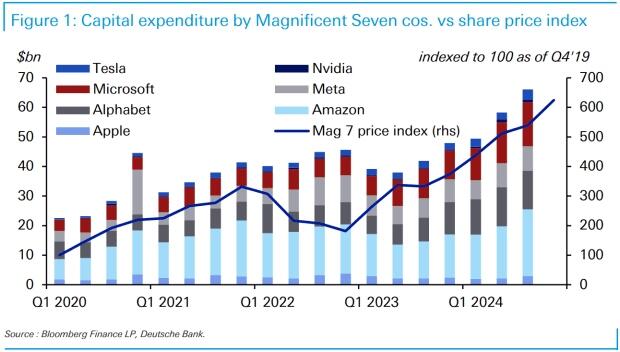
At the heart of the bull case is the emergence of a transformational technology cycle, anchored by artificial intelligence and infrastructure upgrades. Unlike past hype-driven tech cycles, this one is already producing real capital expenditure. The “Magnificent Seven” mega-cap firms have committed more than $600 billion toward data centers, semiconductors, and AI services. This spending has knock-on effects through software, energy, and industrial supply chains. If productivity gains follow, as many expect, earnings will expand and justify higher valuations.

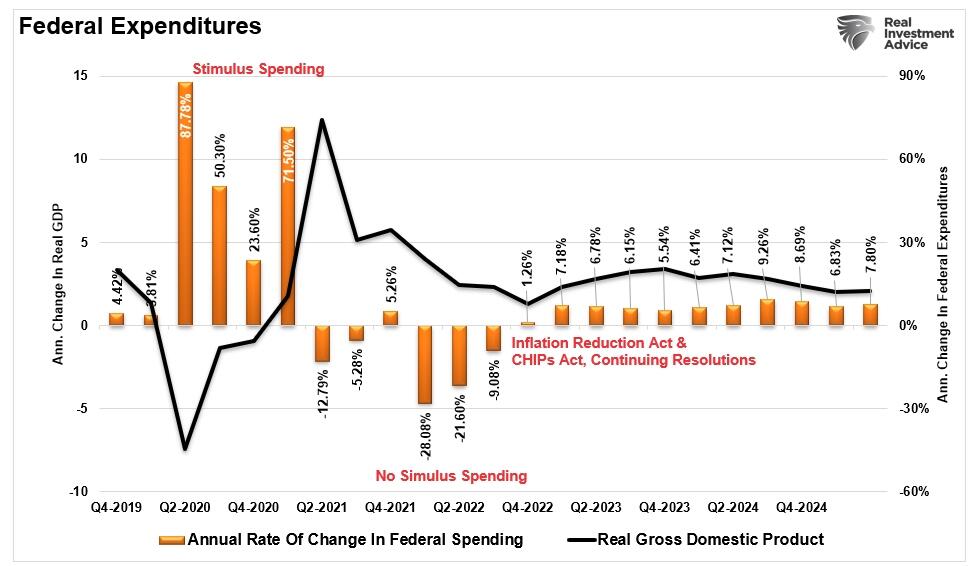
Fiscal policy is also aligned with growth. Under a Trump-led government, tax cuts and direct payments are expected to stimulate both corporate and consumer sectors. The promise of $2,000 stimulus checks may not sound radical, but it boosts near-term consumption and supports small business revenues. Combined with income tax reductions, these measures provide a tailwind for GDP and investor sentiment. As shown, since the 2022 market correction and recession calls, fiscal stimulus has continued to provide steady support for economic growth.

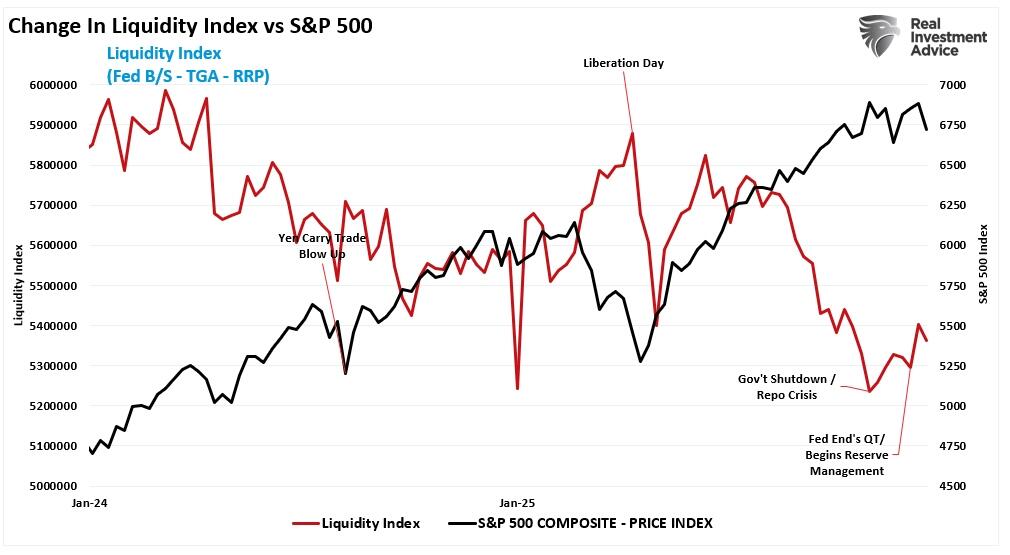
The monetary backdrop is also shifting in favor of the bulls. Quantitative tightening ended in December 2025, and the Federal Reserve is now engaging in “Quantitative Easing Lite” as they continue to cut interest rates and buy $40 billion in short-dated Treasuries. The stated goal is “reserve management,” which is Fed-speak for ensuring there is ample liquidity in the financial system. As the Federal Reserve cuts rates, credit markets should ease, providing risk assets with a tailwind, and liquidity is expected to increase. This dynamic has historically driven higher equity multiples, particularly in technology and growth names.

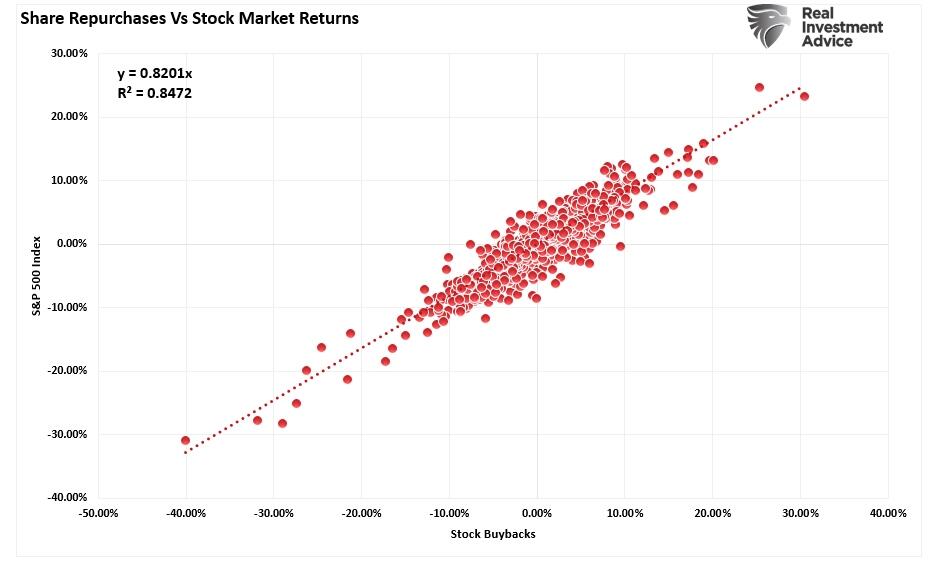
Corporate behavior reinforces the trend. Share buyback authorizations are set to hit a new record of more than $1.2 trillion in 2026. While often quoted as a “capital return strategy,” which it isn’t, there is a clear correlation between buybacks and stock market performance. Particularly, since 2000, corporate buybacks have comprised nearly 100% of all net equity purchases.

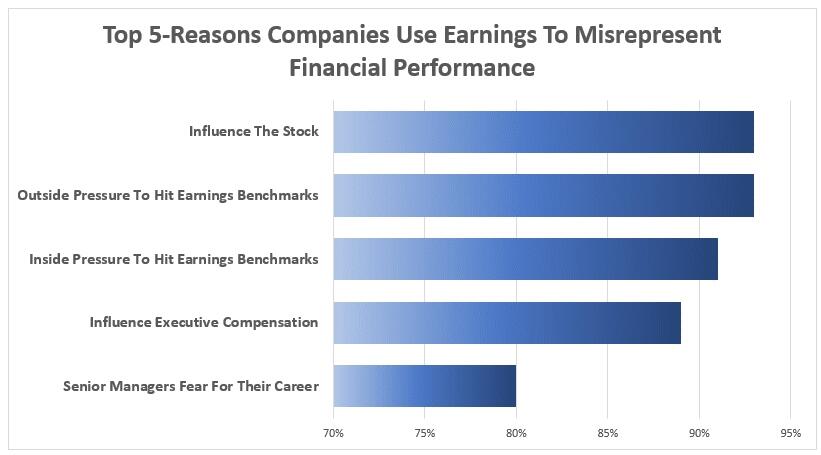
Notably, the narrative that buybacks represent a confidence in future earnings is false; buybacks are being aggressively used to manipulate earnings to exceed Wall Street estimates. Financial engineering is set to expand further in 2026, providing additional support to operating earnings growth and the bullish case.

Lastly, there’s deregulation coming from the “Big Beautiful Bill,” which will ease capital rules on banks, allowing them to hold more collateral. While this provides a tailwind for the Treasury bond market, it also means more lending capacity will be available. Such lending capacity will find its way into leverage for hedge funds and Wall Street trading desks, as looser constraints will translate into an expansion of risk-taking.

The bullish case hinges on a tight feedback loop: innovation drives capital expenditures, which in turn boost earnings, policy injects liquidity, and investors respond with increased risk exposure. So long as each part holds, the trend can continue.

The Bearish Case

The bearish case begins with a critical point: many of the forces that drove 2025’s rally are either fading or already fully priced in. Notably, whether it is valuations, weakening economic indicators, or building speculative risks, the current market momentum may be blinding market participants to deeper structural cracks. However, let’s dig into a few of the issues.

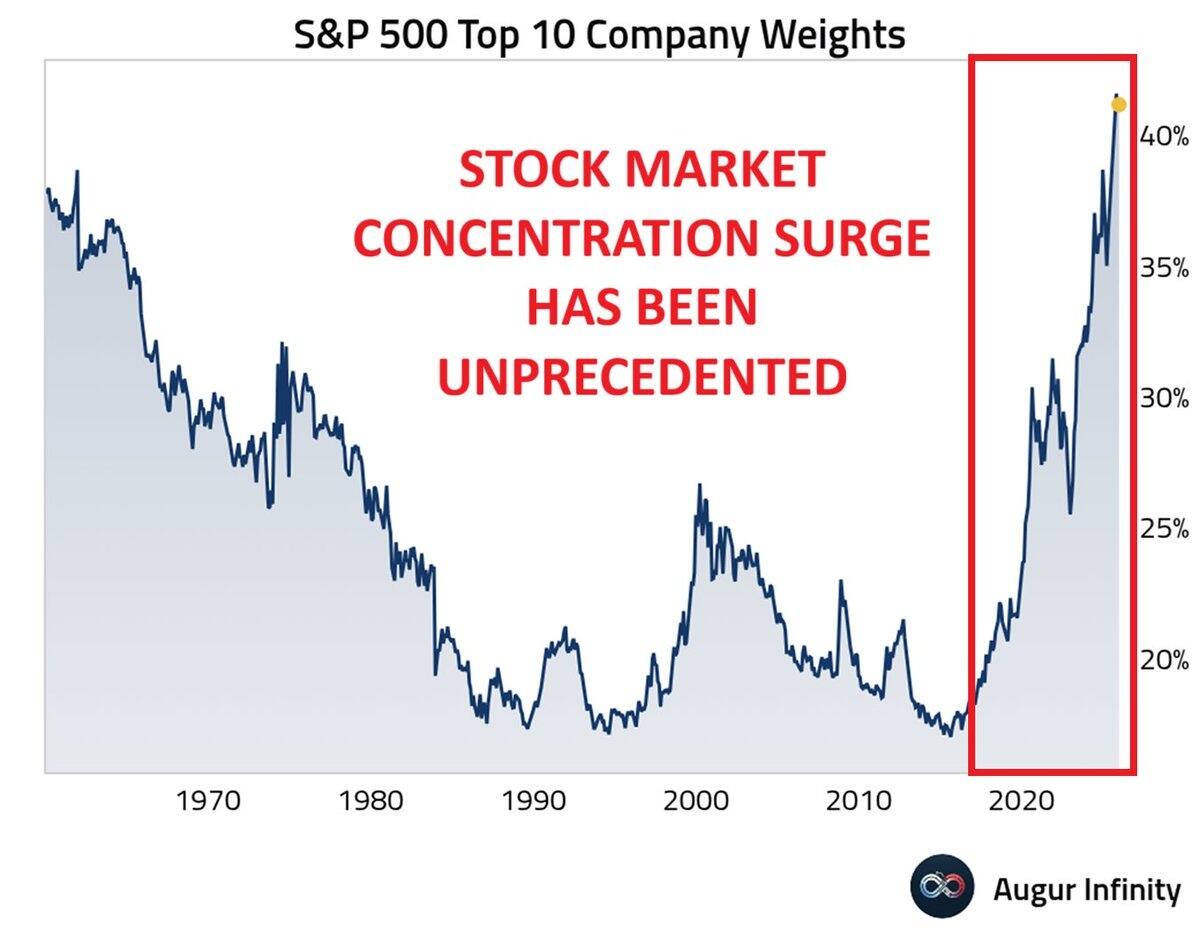
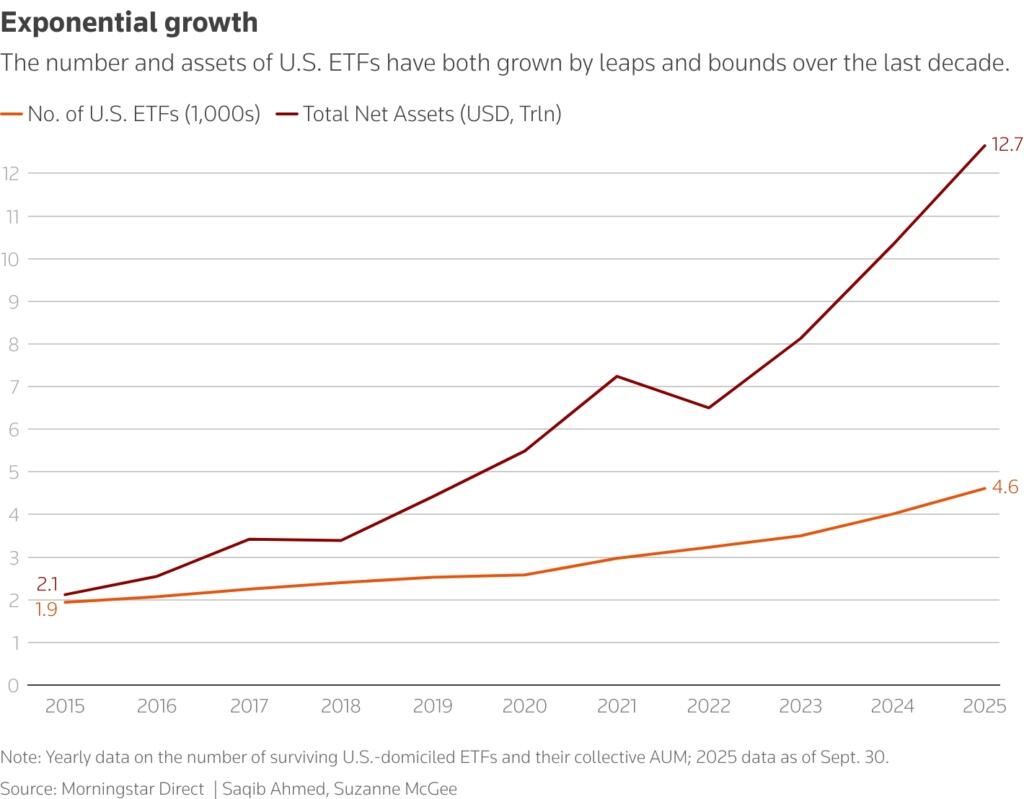
Yes, one of the most obvious concerns is market concentration. Most of the gains in 2025 came from just 10 companies, on a market capitalization-weighted basis, which the massive shift into passive ETF investing fuels.

“Passive investing has grown from a niche strategy into the dominant force in equity markets. Index funds and ETFs now account for over half of U.S. equity ownership. These vehicles allocate capital based on market capitalization, not valuation, fundamentals, or business quality. As more money flows into these funds, the largest companies receive the lion’s share of new capital. That’s created a powerful feedback loop, where price drives flows, and flows drive price.

This narrow leadership is inherently unsustainable. If something occurs that causes investor flows into ETFs to reverse, every dollar sold will pull 40% out of those same 10 companies. History shows that when markets rely on a few names for returns, volatility rises, and drawdowns can be severe.

Valuations are another warning sign. Price-to-earnings ratios on the S&P 500 remain near cycle highs. Growth expectations are lofty, and any disappointment could lead to repricing. AI enthusiasm has fueled a massive wave of investment, but much of it is circular, meaning that firms are spending on AI tools to sell AI products. That feedback loop may eventually hit limits, especially if demand softens or costs outpace returns.

Much of the current investment cycle is also debt-funded as companies borrow to invest, buy back shares, and maintain dividend levels. If rates stay elevated or credit conditions tighten, the cost of that debt could overwhelm earnings gains.

The larger economic concern is that the shift in capital allocation toward tech and automation may leave significant portions of the labor force behind. Yes, during the construction of “data centers,” we may see 5000 people employed, but only 500 are needed post-construction to operate the center. The long-term drag on employment growth will exert upward pressure on demand destruction, and we may already be seeing early signs of that.

Of course, this is the entire basis of the “K-shaped economy. In the current economy, high-income consumers and asset owners are doing well, but lower-income households are under pressure. As a result, consumption patterns are diverging, as lower-tier consumers reduce their spending. That leaves the top 20% of income earners to drive nearly 50% of current consumption. Already, defaults on auto loans and credit cards are rising, and real wages for many workers remain stagnant, even as housing and essential goods continue to be expensive.

Finally, there’s a growing risk in the credit system, especially in the private markets. Private credit has experienced significant growth in recent years, but the lack of transparency hinders its assessment of systemic risk. Regulators have begun to scrutinize this segment, and default rates in middle-market lending are rising. If defaults spread, the ripple effects could hit banks, hedge funds, and pension portfolios alike.

The bear case is not about imminent collapse. It’s about fragility. Beneath the headline gains lies a market vulnerable to earnings misses, credit tightening, and consumer weakness.

Here is the real catch: in 2026, we could see both the bullish and bearish cases. So, being prepared will be key.

Navigating Whatever Comes Our Way

Investors should approach 2026 as a year where both the bullish and bearish cases are proven correct. In the first half, bullish momentum is likely to continue driving gains. Sentiment remains strong, liquidity is ample, and corporate spending continues to ramp up. AI optimism, fiscal stimulus, and a potential pause in tightening may push indexes higher. However, by the second half, cracks could emerge. Valuation pressures are a concern as the risk of an earnings disappointment increases. Economic inequality puts pressure on future outlooks, particularly for corporate revenues. If that happens, sentiment could shift quickly.

To navigate a split-year effectively, investors need to be tactical. The focus will be on capturing early-year upside without overexposing ourselves to potential second-half risks.

Early 2026: Ride Momentum, but Watch Position Size

  • Tilt toward sectors benefiting from capex and liquidity, such as technology, industrials, and energy.

  • Focus on high-quality growth stocks with strong earnings and cash flows, not hype.

  • Use trailing stop-losses to lock in gains if sentiment reverses.

  • Take advantage of short-term dislocations by adding during volatility, but reduce sizing as valuations expand.

  • Avoid overconcentration in AI names, even during rallies — dispersion risk rises with crowding.

Mid-to-Late 2026: Shift Toward Defense and Cash Flow Stability

  • Gradually rotate into value-oriented sectors such as healthcare, consumer staples, and utilities.

  • Increase exposure to dividend-paying companies with strong balance sheets.

  • Raise cash levels or short-duration Treasuries to maintain flexibility.

  • Allocate selectively to high-quality credit, while reducing exposure to private or high-yield debt.

  • Monitor consumer credit, employment trends, and bank earnings for early signs of stress.

Throughout the Year: Stay Disciplined and Objective

  • Stick to valuation rules regardless of narrative shifts.

  • Maintain a diversified portfolio that can absorb both volatility and rotation.

  • Use data, not headlines, to guide allocations.

  • Rebalance regularly, primarily if the first half produces substantial gains that overweight specific sectors.

Tactical flexibility, risk awareness, and discipline will matter more in 2026 than simple bullish or bearish positioning. It is a year where potentially both bulls and bears could be wrong. Historically, markets may not follow a straight line, but your management process should.

2026 will test investors in terms of increased volatility as both the bullish and bearish cases have substance. Yes, a new technology cycle creates real economic momentum, but it also brings risks associated with overstretched valuations, debt-driven growth, and growing social inequality. Markets are pricing in perfection, and historically speaking, such rarely ends as expected.

Whether the year brings another rally or a sharp correction, your results will depend on how well you manage risk. Don’t anchor to either narrative; watch the data, follow your signals, and adjust as needed.

Remember, your investment goal isn’t to chase market returns, but rather to survive and prosper over the range of market cycles.

Trade accordingly.

Tyler Durden Tue, 01/27/2026 - 08:05
[syndicated profile] zeroh_feed

Posted by Tyler Durden

Power Diverted From Data Centers To Households Across PJM Network Amid Historic Freeze

The massive winter storm that disrupted US energy production, sparked the most flight cancellations since Covid, and paralyzed much of the eastern half of the country for days is finally over. BofA chief economist Aditya Bhave has warned that the winter blast could deliver a meaningful hit to first-quarter GDP. However, the eastern half of the US is not in the clear yet. At least another week of brutally cold weather is forecast, which could keep pushing power grids to the brink.

As heating demand surged to record levels, fossil fuel power generation proved critical in preventing widespread rolling blackouts. James Bevan of Criterion Research made that clear in an exclusive note for ZeroHedge:

To further stabilize the power grid this week, Energy Secretary Chris Wright instructed PJM Interconnection on Monday to divert power intended for data centers and other energy-intensive facilities to residential customers and hospitals. Those data centers and facilities were able to switch on their on-site diesel and natural gas generators, reducing power demand during peak hours.

Bloomberg notes:

PJM, which serves more than 67 million people from Chicago to Virginia, sought federal approval to stave off the potential need to impose rolling blackouts. Wright also gave the same authorization to two units of Duke Energy Corp.

The move by Wright to divert power intended for data centers to residential customers and hospitals comes as average temperatures in Washington, DC, at the heart of the PJM grid in the energy crisis-stricken Mid-Atlantic, are in the low teens this week. The two-week forecast is not expected to rise above the 30-year average.

This period also coincides with peak winter in the Northern Hemisphere. Historically, the 30-year seasonal average temperature for the Lower 48 does not begin to trend higher until next month.

As of this morning, wholesale electricity prices in the PJM grid soared 241% to more than $2,300 per megawatt-hour.

Meanwhile, residents across Central Maryland are being financially crushed by a worsening power bill crisis, the result of green energy policies that have backfired in the one-party ruled state ruled by Democratic Party kings and queens. The grid mismanagement stems from a failed climate alarmism framework that collided head-on with the rapid buildout of energy-hungry data centers.

Read:

Insurmountable household power bill debt is sparking public anxiety aimed squarely at Annapolis lawmakers. It's not just Maryland, the power bill crisis has erupted across the Northeast states. 

Tyler Durden Tue, 01/27/2026 - 07:45
[syndicated profile] zeroh_feed

Posted by Tyler Durden

De-Dollarization? Gold Over Debt - The End Of The Keynesian Paper Promise Mirage

Authored by Daniel Lacalle,

Despite the consensus narrative, what we are currently experiencing globally is not “de‑dollarization,” but a broad loss of confidence in developed economies’ fiat currencies and sovereign debt as a reserve asset for central banks and institutions. This fundamental loss of confidence in the solvency of developed economies’ sovereign issuers is boosting demand for gold.

However, the latest data shows no crossover or fiat alternative substitution. The US dollar’s central role in the fiat system remains intact.

Gold over debt: the key shift

MMT supporters state that monetary sovereign nations can issue all the debt they want without inflationary and confidence risk. However, monetary sovereignty is not a given; it is not perennial and governments face three limitations when it comes to issuing debt. Domestic and global confidence in sovereign issuers begins to decline once they surpass those limits.

The three limits for governments are:

  1. the economic limit, when more government debt leads to stagnation and productivity growth decline;

  2. the fiscal limit, when interest expenses and debt burdens soar despite central bank easing and rising tax receipts;

  3. and the inflationary limit, when the loss of the purchasing power of currencies becomes large and persistent, eroding citizens’ standards of living.

Over the last few years, the most important trend in global reserves has been the rotation from government bonds of advanced economies toward gold, not “out of dollars,” as some media highlights, and even less so into other fiat currencies.

Many analysts blame the recent sanctions against Russia as a factor that has triggered the move to other forms of reserve. However, this does not seem like a plausible cause when most of the gold reserves that have been added globally are stored in countries that enforce those sanctions. The evidence is more complex and different: Central banks globally stopped trusting in developed nations’ debt as their core asset in 2021 when inflationism and lack of fiscal responsibility started generating losses at major central banks. Sovereign debt stopped being the quality, stable, and income-generating asset that provided real economic returns to institutions all over the world.

Despite the media and social media comments, the slump of euro and yen assets as reserves has been more aggressive than that of the US dollar. Bloomberg and the World Gold Council data show central banks and sovereign funds have doubled the pace of gold purchases in roughly three years, accumulating around 80 metric tons a month and driving record demand and record prices. This buying comes on top of strong private-sector investment demand, turning gold into the main beneficiary of rising concerns about debt sustainability and currency debasement in the US, Europe, Japan, and the UK. At the same time, analysts at JP Morgan highlight that much of this official gold buying is opaque, with significant “unreported” flows via hubs such as Switzerland, which reinforces the idea of a stealth shift into a real asset outside the fiat system.

The real underlying driver is the deterioration in the fiscal and monetary credibility of developed economies. Government debt is close to peacetime record levels, while long‑term spending commitments, unfinanced liabilities, weak growth, and aging populations make future fiscal consolidation politically challenging. Since the pandemic, major central banks have combined ultra‑loose policy, large balance sheets, and implicit financial repression to maintain the illusion of solvency of sovereign issuers, which has strengthened the view that fiat currencies will be used to manage debt through inflation and negative real rates for a long time. The freezing of Russian reserves in 2022 and the weaponization of sanctions only served as a confirmation of the debasement risk and convinced many emerging‑market central banks that holding large stocks of G7 sovereign debt and deposits entails growing political and legal risk. Faced with a mix of fiscal excess, financial repression, and geopolitical risk, reserve managers have finally returned to the strategy of adding reserves in an asset with no counterparty risk. The famous “gold is money, everything else is debt” sentence becomes more relevant than ever.

Dedollarization requires a fiat alternative crossover.

The same sources that show soaring gold demand also show that there is no true “dedollarization” in the sense of a fiat‑to‑fiat substitution. This also makes sense. The US dollar is the world’s strongest weak currency because it has a higher level of liquidity, more independent institutions, and better legal and investor security than any alternative. The US dollar is losing its place as a global reserve to gold but not losing its position relative to the euro, yen, pound, or yuan.

IMF COFER figures show that the US dollar’s share of allocated FX reserves remains at 59.6%, and when adjusted for exchange‑rate moves, the IMF itself concludes that the dollar’s share has been broadly stable, with recent declines explained mostly by valuation effects, not active selling. The euro, at 20.3%, is not even close to being a contender. The euro, yen, sterling, and even the Chinese renminbi have not captured the supposed “lost” dollar share. Their combined importance in reserves is flat or declining, while the rising share belongs to gold and “other assets,” including silver, oil, or domestic equities in the case of Japan.

BIS FX turnover and SWIFT payment data allow us to reach the same conclusion. The dollar is on almost 90% of all FX transactions and roughly half of global SWIFT payments, with the euro a distant second and the renminbi still only a low‑single‑digit share. There is no crossover where another fiat currency replaces the dollar’s role in trade, finance, or reserves. The real story is that all major fiat currencies are losing relative trust to an asset outside the system, like gold.

Institutions all over the world have suffered losses with sovereign debt since 2021 and see no end to the inflationary currency debasement policy, while solvency is under question as governments reject any form of spending control.

Calling this “de‑dollarization” is misleading, because it suggests a transition from a dollar‑centric order to a euro‑, yuan‑ or BRICS‑centric fiat order, something the data clearly do not show. What is actually happening is better described as “de‑fiatization at the margin,” a shift away from all heavily indebted, policy‑managed fiat currencies towards real assets that do not depend on governments. The dollar remains the least‑imperfect fiat currency, with unmatched liquidity, legal and investor security, and support in trade and finance, so there is no scalable alternative that reserve managers can move into without assuming even greater risk. That is why central banks diversify some of the marginal flow into gold but keep the bulk of their liquid reserves, payment systems, and FX operations in US dollars.

The world is penalizing the fiscal and monetary excesses of developed economies by demanding less of their debt and more gold, not by building a new fiat‑currency alternative. The record highs of gold and the constant purchases by central banks indicate a lack of confidence in the long-term purchasing power and credit quality of sovereign issuers, not in a competing fiat currency. Meanwhile, the dollar’s share in reserves, trade invoicing, FX turnover, and payments remains dominant and broadly stable, with no evidence of a large‑scale substitution into euros, renminbi, or any other fiat unit.

The global system is therefore not moving from “dollar hegemony” to “yuan hegemony” or a multipolar fiat regime; it is moving from unchallenged trust in developed‑market paper to a world where gold re‑emerges as the ultimate reserve asset, and the dollar stays at the declining fiat center because nothing else can replace its security, infrastructure, and depth.

While investors legitimately worry about America’s credit credibility and the US dollar’s purchasing power, no one is naive enough to consider the euro area, Japan, China, or a basket of serial devaluators like the BRICS as viable alternatives to the US dollar.

The solution is to go back to sound money policies. However, no fiat currency issuer seems to want that shift. No government desires a strong currency because it undermines their illusion of paper promises.

Tyler Durden Tue, 01/27/2026 - 07:20

Profile

eledjo: (Default)
eledjo

June 2025

S M T W T F S
12 34567
891011121314
15161718192021
22232425262728
2930     

Style Credit

Expand Cut Tags

No cut tags
Page generated Jan. 29th, 2026 03:40 am
Powered by Dreamwidth Studios