[syndicated profile] zeroh_feed

Posted by Tyler Durden

Southwest Airlines Ends Open Seating, Moves To Reservation-Based System

Authored by Rob Sabo via The Epoch Times,

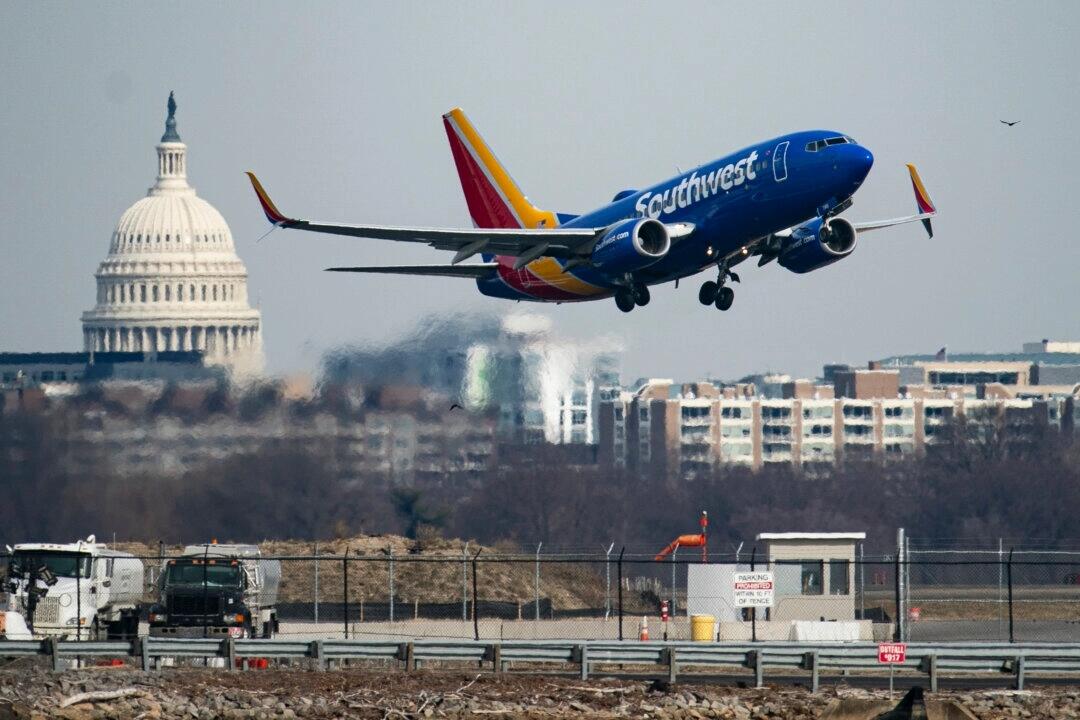
Southwest Airlines’ era of offering passengers open seating is officially ending, as the passenger carrier transitions its seating policy to a reservation-based system common with other airlines starting on Jan. 27.

Southwest announced last summer that it would end its open seating policy to offer customers a wider range of seating options. The airline’s new booking model includes three seating options: standard seating at the back of the aircraft; preferred seating near the front; and extra legroom seats in the front of the cabin and at the exit rows.

Southwest said it will also initiate a new group-based boarding process to replace its old “A,” “B,” and “C” boarding system that encouraged travelers to check in 24 hours prior to departure to secure the coveted “A” boarding option. The new boarding system will be skewed toward passengers who book premium seating options, while customers who choose basic seating will board last. Southwest will need to make physical changes to its departure gates to accommodate the new system, which could take months to complete.

Tony Roach, Southwest Airlines’ executive vice president of customer and brand, said the changes allow customers more choice and control over their flying experience.

“Assigned seating unlocks new opportunities for our customers—including the ability to select extra legroom seats—and removes the uncertainty of not knowing where they will sit in the cabin,” Roach said in a statement announcing the booking shakeup.

“This is an important step in our evolution, and we’re excited to pair these enhancements with our legendary customer service.”

The airline’s new “basic” fare option—formerly called Wanna Get Away—is nonrefundable and does not allow any changes in travel dates or times unless passengers upgrade to a higher tier. Choice Extra is the new name for its former business select option and includes two free checked bags along with priority boarding.

Southwest said on its website that the new booking policy for the extra legroom seats may clash with existing corporate business accounts, which offered priority boarding so business travelers could get first dibs on seats in the front of the plane or those with extra legroom.

“We recognize these changes may impact how business customers interact with Southwest Business,” the airline said. “We are actively working through details on how best to offer updated contractual benefits into future corporate travel agreements, and we will strive to keep you informed on any updates.”

The airline also announced it would change its policy regarding larger travelers who require more room. Starting Jan. 27, passengers who don’t fit within a seat’s armrests will be required to purchase an additional seat. Previously, the airline offered larger passengers the option to purchase a fully-refundable seat or ask for a free one at the gate.

Southwest Airlines’ final flight featuring open seating departed from Honolulu on Jan. 26 and arrived in Los Angeles this morning.

Southwest Airlines has offered open seating since its first flights to Houston and San Antonio from Love Field in Dallas in the summer of 1971. The company went public on the New York Stock Exchange in 1977.

Tyler Durden Tue, 01/27/2026 - 10:30
[syndicated profile] zeroh_feed

Posted by Tyler Durden

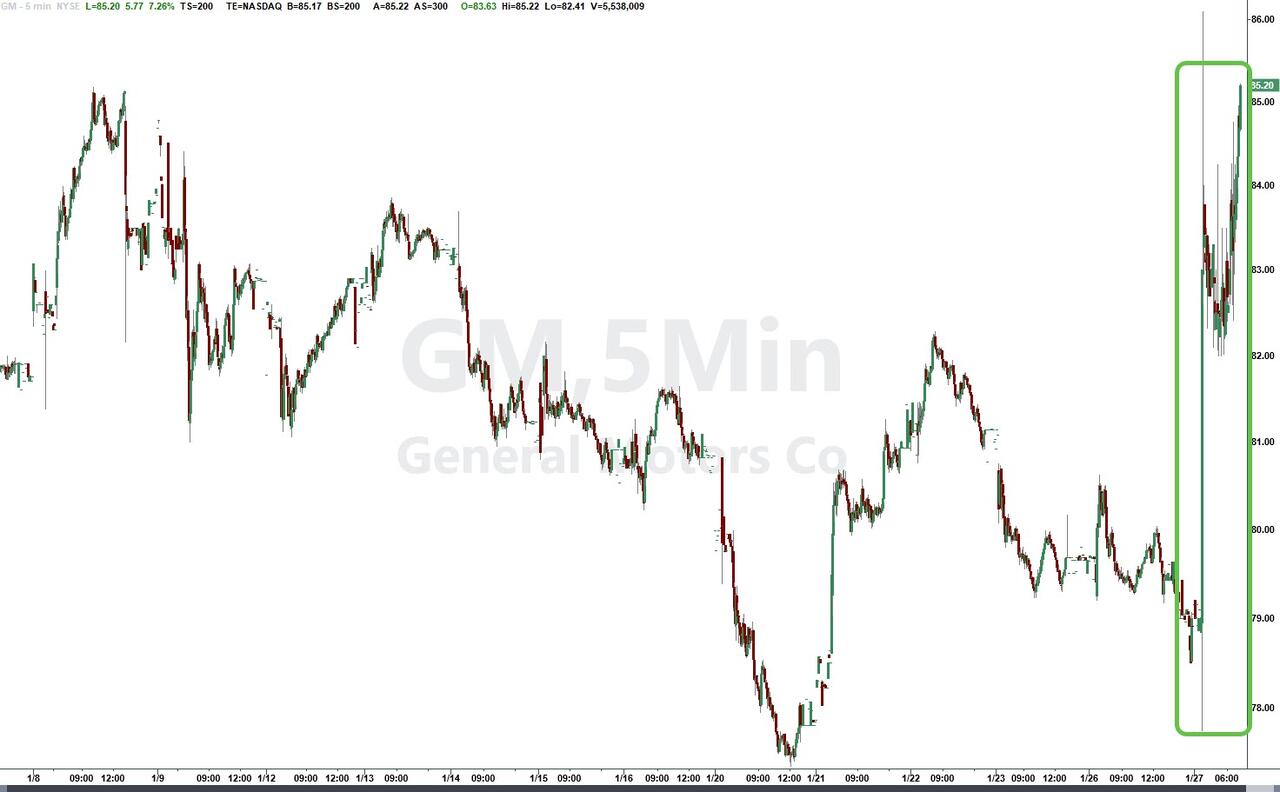
GM Shares Surge 7% After Surpassing Q4 Estimates, Raising Guidance, Planning $6B Stock Buyback

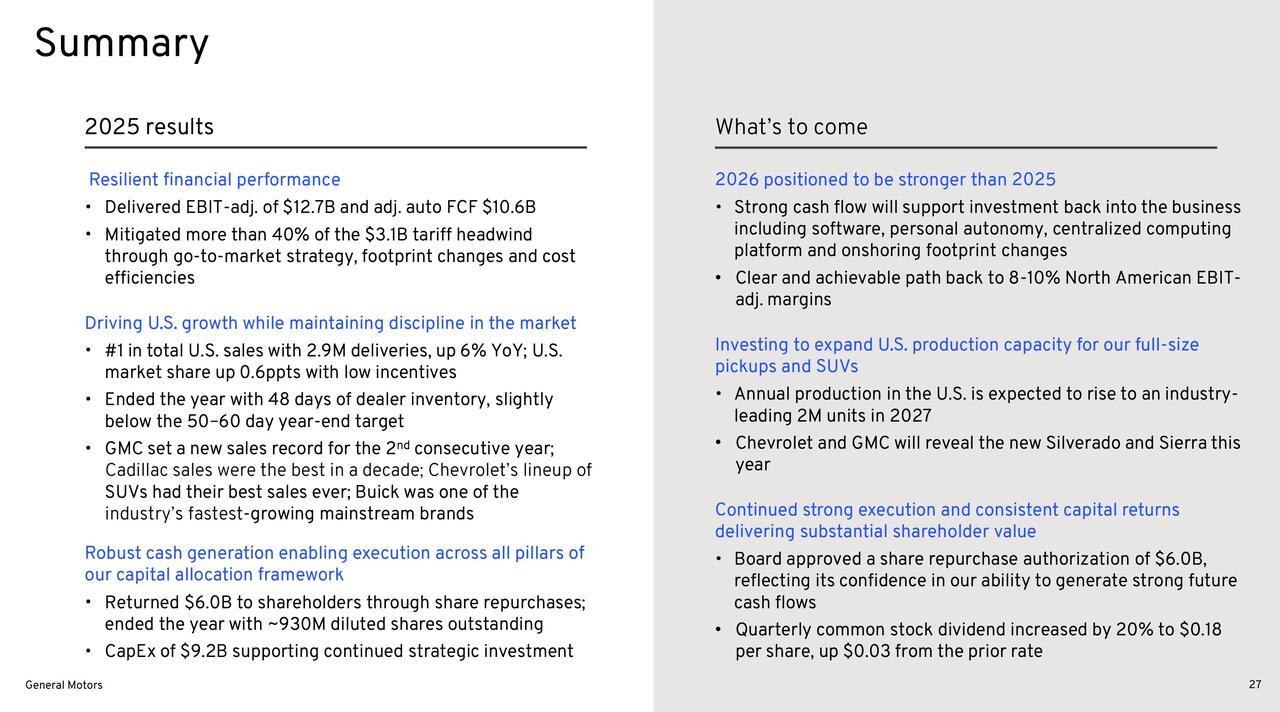
General Motors exceeded Wall Street’s fourth-quarter earnings expectations and forecast another year of “strong financial performance” in 2026. While revenue fell slightly short, the company announced a 20% dividend increase and a new $6 billion stock buyback program, according to CNBC and GM.

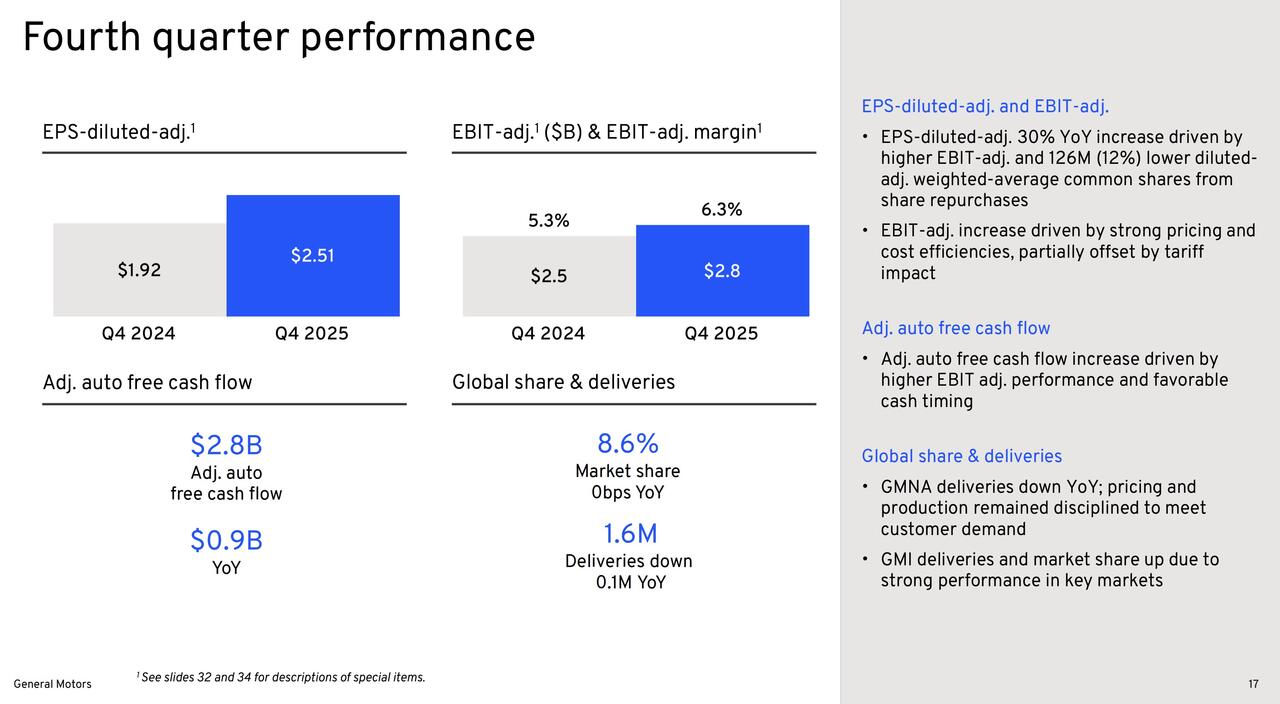
GM reported adjusted earnings per share of $2.51, beating estimates of $2.20, though revenue of $45.29 billion missed expectations.

Shares rose about 7% in early trading.

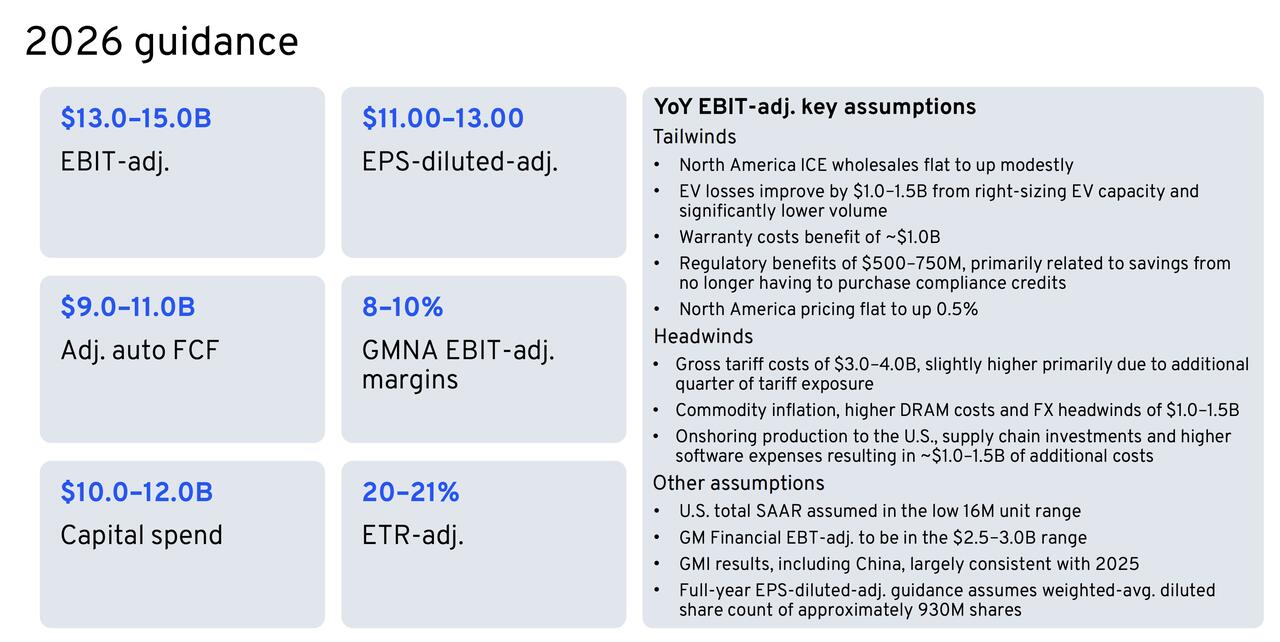
For 2026, GM projects net income of $10.3 billion to $11.7 billion, adjusted EBIT of $13 billion to $15 billion, and earnings per share between $11 and $13. These forecasts reflect continued investment of $10 billion to $12 billion as the company reevaluates its shift toward electric vehicles.

CEO Mary Barra said GM expects North American profit margins of 8% to 10% this year, up from 6.8% in 2025. She added that GM remains “in a strong position to return capital to shareholders.”

In 2025, GM posted net income of $2.7 billion and adjusted EBIT of $12.7 billion, both down sharply from 2024. Revenue fell 1.3% to $185.02 billion.

The company reported a fourth-quarter net loss of $3.3 billion, driven largely by more than $7.2 billion in special charges tied to EV cutbacks, legal issues, restructuring in China, and the shutdown of Cruise.

Barra said GM’s smaller Detroit headquarters is expected to save “hundreds of millions of dollars” each year.

The report says that the new buyback and dividend increase to 18 cents per share continue GM’s effort to reduce shares outstanding, which fell to 904 million at the end of 2025.

North America remained GM’s strongest region, though profits declined 28.1% to $10.45 billion. International operations improved, while losses in China narrowed.

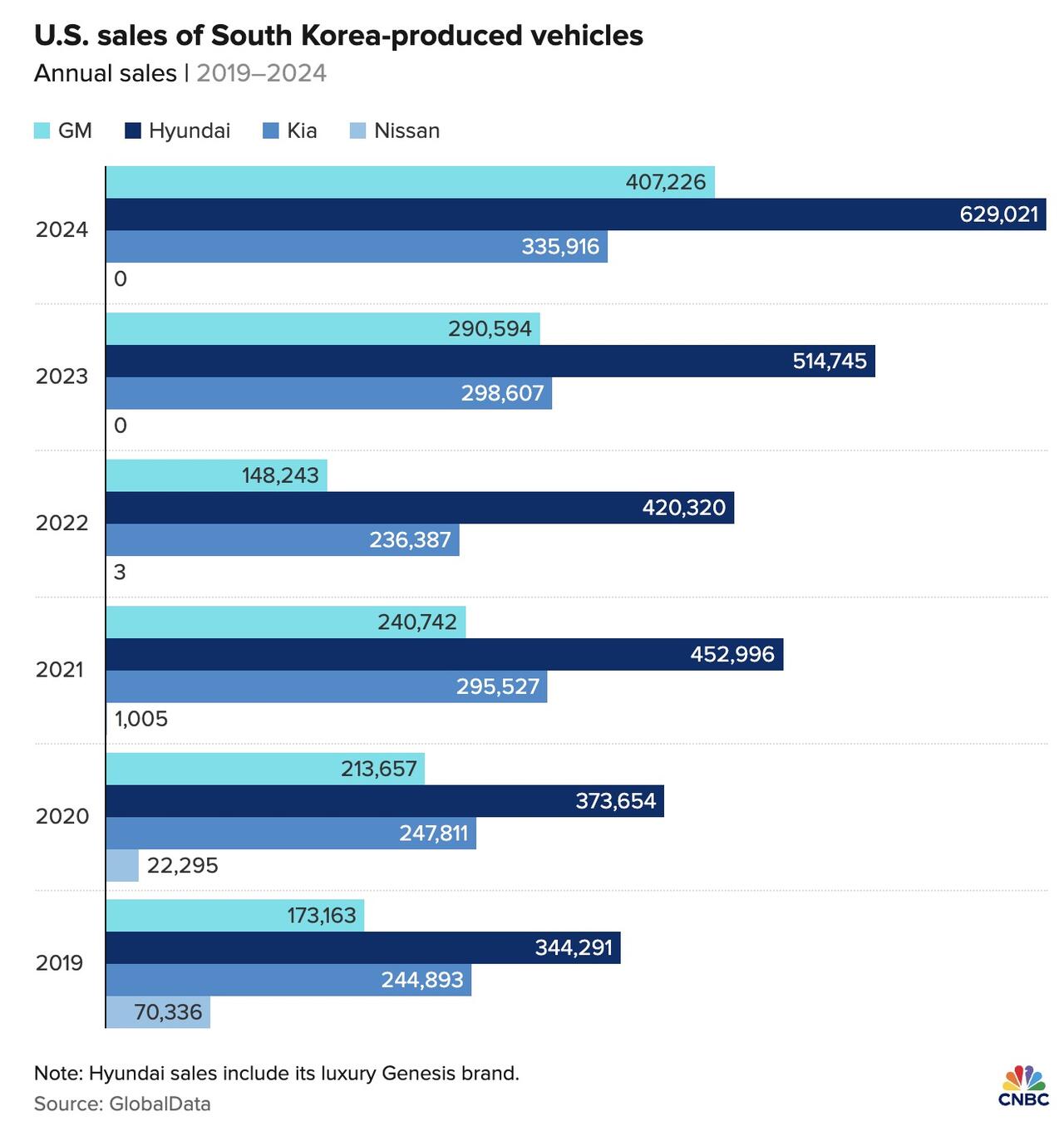
CFO Paul Jacobson said U.S. tariffs cost GM $3.1 billion in 2025. Barra said the company is “hopeful” the U.S. and South Korea will finalize a trade deal with a 15% tariff, warning that higher tariffs could hurt costs.

“We’re really encouraging the countries to get the trade deal done,” Barra said.

GM continues to rely on South Korea for entry-level vehicles such as the Chevrolet Trax and Buick Envista, making trade policy a key issue for its future performance. 

Tyler Durden Tue, 01/27/2026 - 10:20
[syndicated profile] zeroh_feed

Posted by Tyler Durden

Conference Board Consumer Confidence Crashes To 12 Year Lows

After Boomers and Gen X dragged The Conference Board Confidence measure down to eight month lows to end 2025, expectations were for a rebound to start 2026.

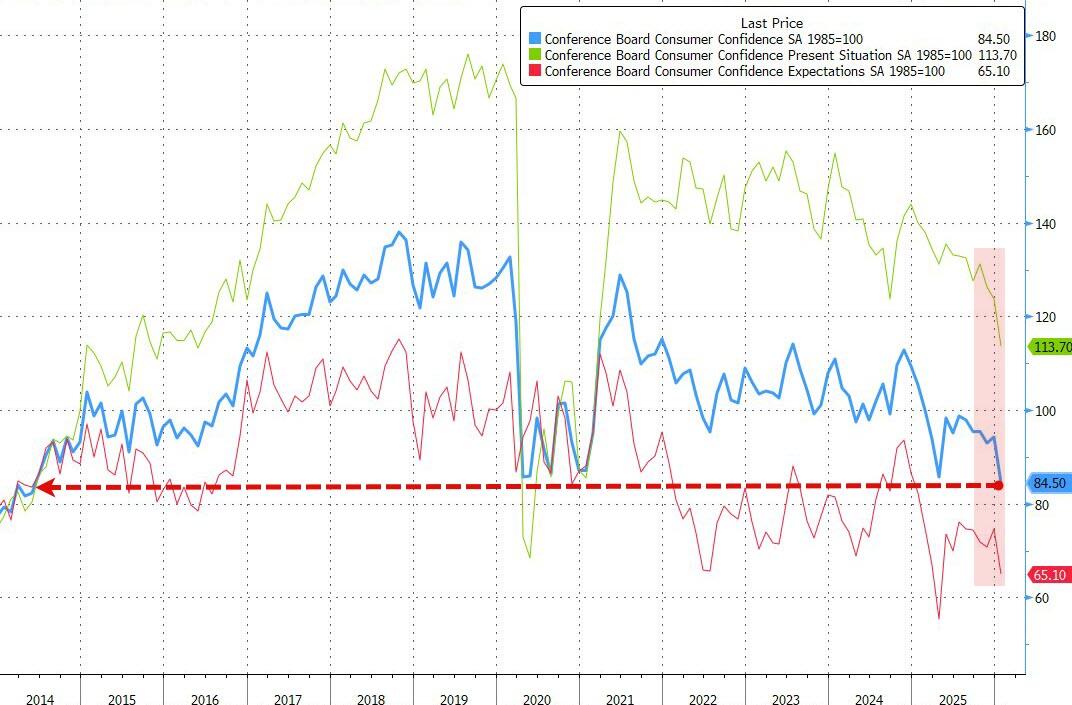
But, reality was far worse with the headline plunging from 94.2 (revised up from 89.1) to 84.5 (well below the 91.0 expected) - the lowest since May 2014.

The Present Situation Index - based on consumers’ assessment of current business and labor market conditions - plummeted by 9.9 points to 113.7 in January (from an upwardly revised 123.6).

The Expectations Index - based on consumers’ short-term outlook for income, business, and labor market conditions - tumbled to 65.1 (from 74.6).

Source: Bloomberg

The Expectations Index has now tracked under 80 for 12 consecutive months, the threshold below which the gauge signals recession ahead.

“Confidence collapsed in January, as consumer concerns about both the present situation and expectations for the future deepened,” said Dana M Peterson, Chief Economist, The Conference Board.

“All five components of the Index deteriorated, driving the overall Index to its lowest level since May 2014 (82.2)—surpassing its COVID-19 pandemic depths.”

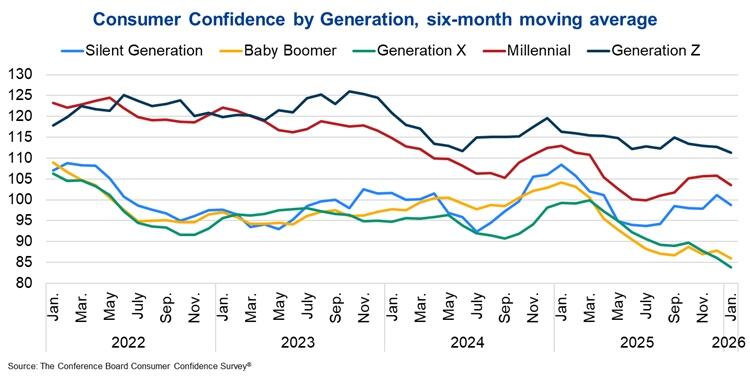
Among demographic groups, confidence on a six-month moving average basis dipped for all age groups in January, although consumers under 35 continued to be more confident than consumers age 35 and older.

Confidence among all generations trended downward in the month, but Gen Z remained the most optimistic of all generations surveyed.

By income, confidence on a six-month moving average basis ticked downward for all brackets, and consumers earning less than $15K remained the least optimistic among all income groups.

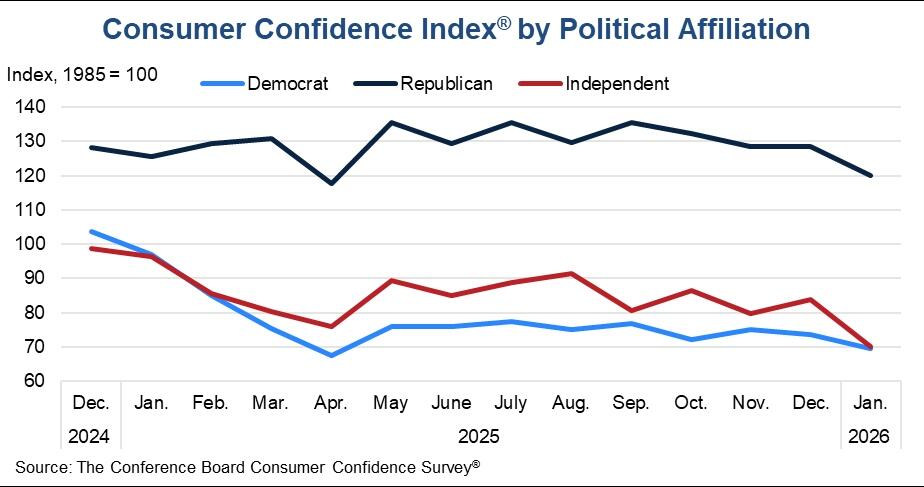
Consumer confidence continued to fade in January among all political affiliations, with the sharpest decline among Independents.

Peterson added:

Consumers’ write-in responses on factors affecting the economy continued to skew towards pessimism. References to prices and inflation, oil and gas prices, and food and grocery prices remained elevated.

Mentions of tariffs and trade, politics, and the labor market also rose in January, and references to health/insurance and war edged higher.”

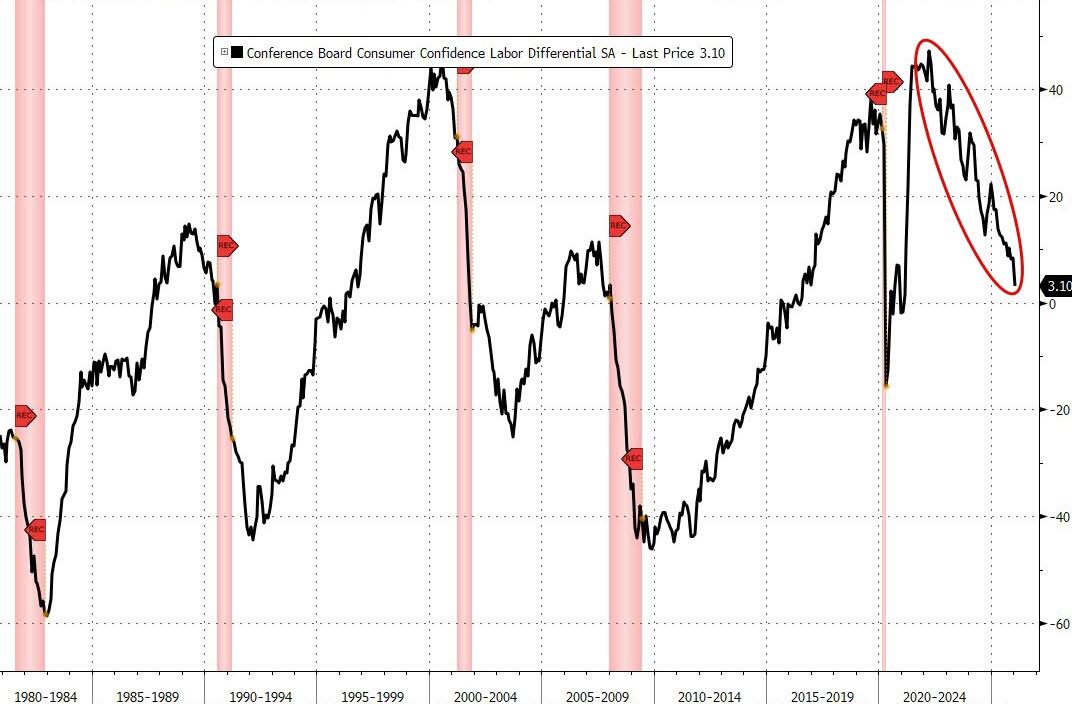
Finally, under the hood, The Conference Board survey shows the trend of a weaker labor market continued to accelerate...

Source: Bloomberg

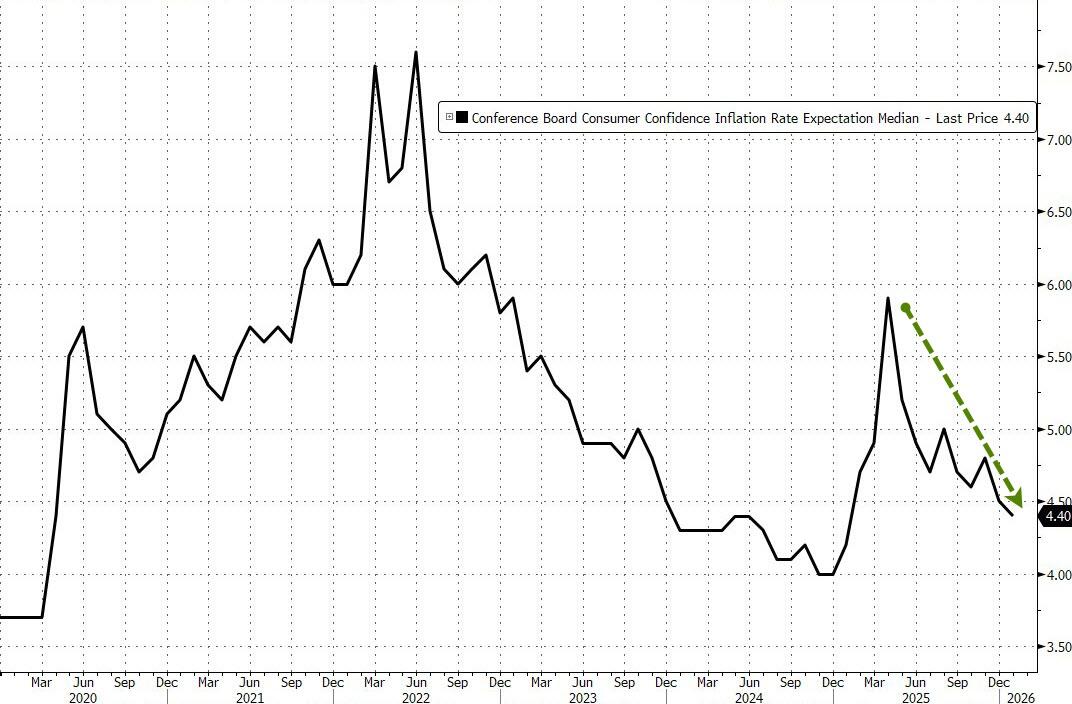
While the labor market languishes, inflation expectations have tumbled (just like they did in the UMich survey)...

Source: Bloomberg

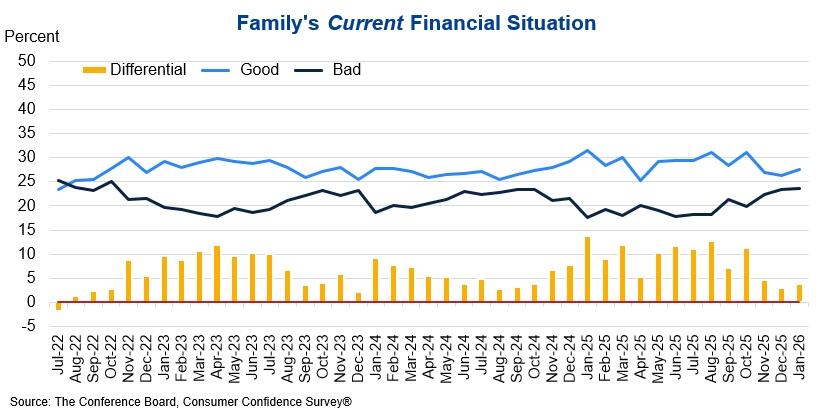
One final (slight) silver lining was that, on net, consumers’ views of their Family’s Current Financial Situation improved slightly in January, after a plunge into negative territory in December was revised upward to reveal a small net positive. 

So, the stock market soars near record highs, GDP is ripping, but consumer sentiment is collapsing?

Tyler Durden Tue, 01/27/2026 - 10:10
[syndicated profile] zeroh_feed

Posted by Tyler Durden

Trump Admin Wins Appeal Of ICE Injunction In Minnesota

Authored by Jonathan Turley,

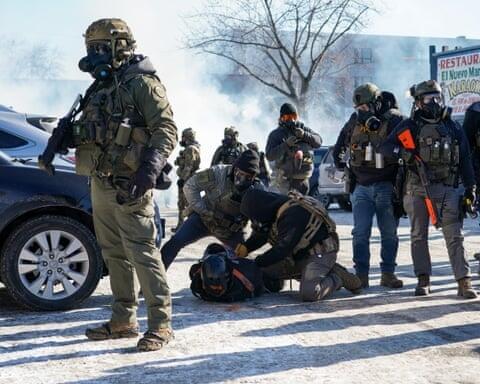
In a significant victory for the Trump Administration, a panel of the United States Court of Appeals for the Eighth Circuit lifted the injunction of U.S. District Judge Katherin Menendez, who prevented officers from arresting, detaining, pepper-spraying or retaliating against protesters in Minneapolis without probable cause.

In her Jan. 16 decision, Judge Menendez (a Biden appointee and former public defender) ruled in favor of the protesters suing the Department of Homeland Security (DHS) and ICE. She found the plaintiffs were likely to succeed on claims that federal agents violated their First and Fourth Amendment rights.

The Eighth Circuit first flagged how Menendez ignored the fact that the record shows a wide range of conduct raising different conditions for law enforcement:

“We accessed and viewed the same videos the district court did. … What they show is observers and protestors engaging in a wide range of conduct, some of it peaceful but much of it not. They also show federal agents responding in various ways. Even the named plaintiffs’ claims involve different conduct, by different officers, at different times, in different places, in response to different behavior. These differences mean that there are no “questions of law or fact common to the class,” Fed. R. Civ. P. 23(a)(2), that would allow the court to decide all their claims in “one stroke.”

The panel also found Judge Menendez’s order unacceptably vague:

“Second, in addition to being too broad, the injunction is too vague.

…Even the provision that singles out the use of “pepper-spray or similar nonlethal munitions and crowd dispersal tools” requires federal agents to predict what the district court would consider “peaceful and unobstructive protest activity.” The videos underscore how difficult it would be for them to decide who has crossed the line: they show a fast-changing mix of peaceful and obstructive conduct, with many protestors getting in officers’ faces and blocking their vehicles as they conduct their activities, only for some of them to then rejoin the crowd and intermix with others who were merely recording and observing the scene.”

The panel found that Judge Menendez’s order left federal authorities in a dangerous position of not knowing when they could use these crowd control measures: “to the extent the injunction’s breadth and vagueness cause federal agents to hesitate in performing their lawful duties, it threatens to irreparably harm the government and undermine the public interest.”

Notably, Judge Menendez is the same judge reviewing an even more sweeping motion for an injunction to enjoin ICE operations, a filing from Minnesota Attorney General Keith Ellison that I have criticized as constitutionally meritless.

Here is the opinion: Tincher v. Noem

Tyler Durden Tue, 01/27/2026 - 09:45
[syndicated profile] zeroh_feed

Posted by Tyler Durden

From Bad To Worse: UnitedHealth Posts First Annual Revenue Drop In Three Decades

Things have gone from bad to worse for UnitedHealth Group since late Monday.

First, the Trump administration's plan to keep Medicare Advantage rates roughly flat next year (read the report) sent shares tumbling during the after-hours session on Monday evening.

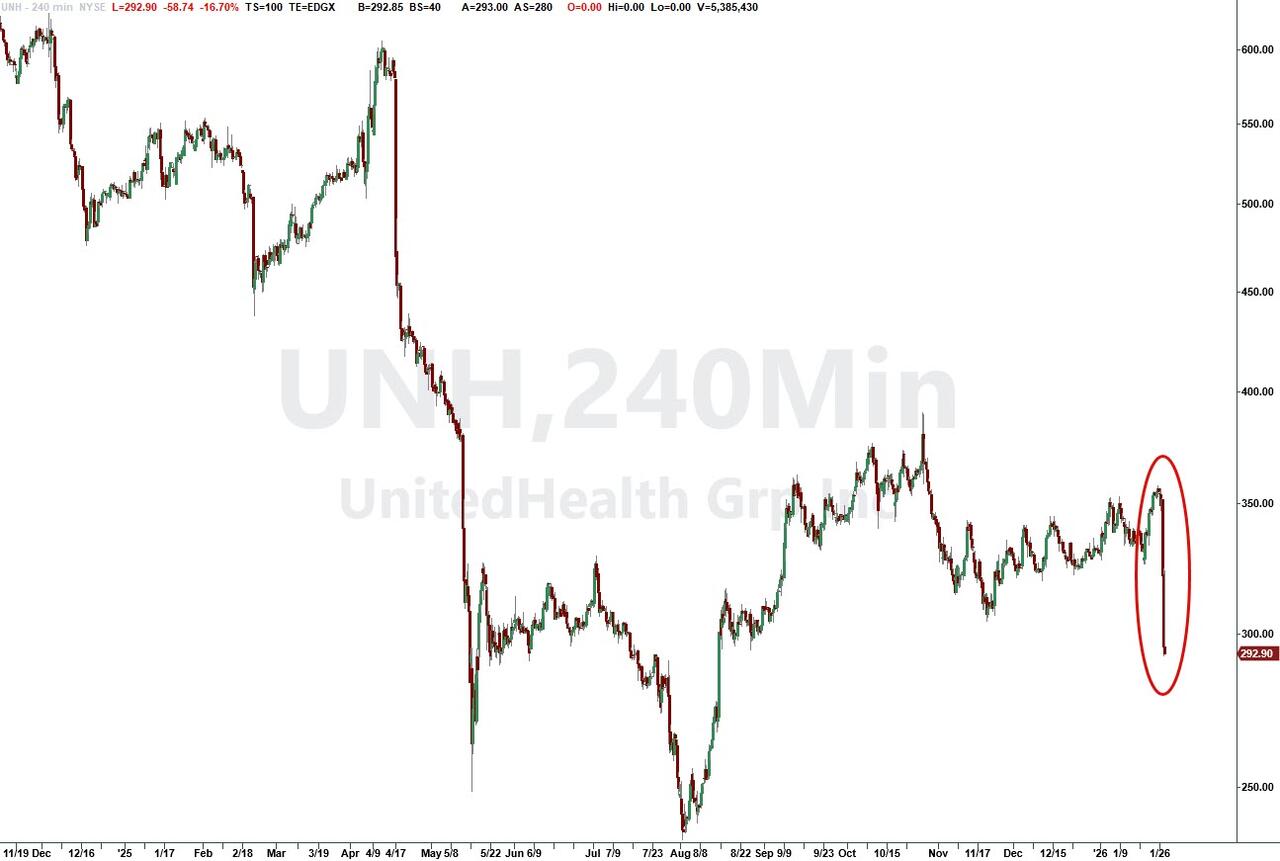
The selloff intensified in premarket trading after the 2026 outlook and quarterly earnings disappointment. The stock plunged as much as 17% ahead of the cash opening in New York.  

UNH shares were already down about 8% heading into the earnings release. Shares extended losses after the insurer forecasted a decline in 2026 revenue, marking its first annual contraction in more than three decades.

Summary of the 2026 Outlook:

  • Adjusted EPS: Guided above $17.75, modestly ahead of the $17.69 Bloomberg Consensus.

  • Revenue: Forecast above $439B, well below the $455B Bloomberg Consensus, signaling top-line pressure.

  • Operating cash flow: Expected above $18B, trailing the $19.7B estimate.

The takeaway from this year's outlook: Profit guidance is slightly better than expected, but the revenue and cash flow outlooks underwhelm analysts' estimates tracked by Bloomberg.

For the fourth quarter, UnitedHealth posted adjusted earnings of $2.11 per share, while revenue climbed 12% year over year to $113.22 billion. Wall Street analysts tracked by Bloomberg had been expecting $2.10 per share on revenue of $113.87 billion.

Summary of the 4Q24 Earnings:

Earnings: Adjusted EPS of $2.11 beat estimates by a cent but fell from $6.81 y/y. Reported EPS was $0.1 vs. $5.98 y/y.

Revenue: $113.22B, up 12% y/y, but missed Bloomberg Consensus of $113.87B.

Segment performance

  • UnitedHealthcare: $87.11B, +18% y/y, above expectations.

  • Optum total: $70.33B, +8% y/y, ahead of estimates.

  • OptumRx: $41.46B, +16% y/y, beat estimates.

  • OptumHealth: $25.54B, -0.5% y/y, roughly in line.

  • OptumInsight: $5.04B, +5.5% y/y, modest beat.

Margins and costs:

  • Medical care ratio: 92.4%, worse than the 92.1% estimate.

  • Operating margin: 0.3%, sharply down from 7.7% y/y and well below the 2.9% estimate.

Enrollment: 49.76M members, below the 51.13M consensus.

The combination of the Trump administration's plan to keep Medicare Advantage rates roughly flat and the first annual revenue drop in three decades disappoints investors, with shares down 17% in premarket trading. This is the largest intraday decline since the May 13, 2025, 17.8% decline.

"We confronted challenges directly and finished 2025 as a much stronger company, giving us the momentum to better serve those who count on us and continue to improve our core performance," UNH CEO Stephen Hemsley wrote in a statement.

Tyler Durden Tue, 01/27/2026 - 09:30
[syndicated profile] zeroh_feed

Posted by Tyler Durden

The Grid Will Hold - Maybe - But The Bill Will Rise

Authored by Terry L. Headley via RealClearEnergy,

Americans are about to pay a lot more for electricity anyway — not because the grid fails, but because of how we now power it.

As another deep winter cold snap presses across much of the eastern United States, grid operators are doing what they always do in these moments: watching reserve margins, issuing conservation guidance, leaning on dispatchable generation, and quietly hoping nothing large trips offline at the wrong hour.
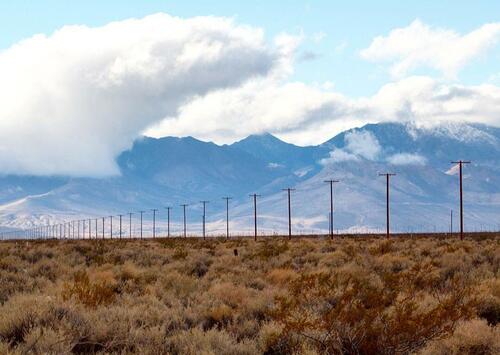
If history is a guide, the system will muddle through. It usually does. But survival isn’t the same thing as success. And it’s certainly not the same thing as affordability.

Even if there is no blackout, no emergency load shedding, and no headline-grabbing crisis, this weather event will still deliver a financial shock — one that will show up first in gas markets, then in wholesale power prices, and finally, months later, in the electric bills of households and businesses. That downstream billing impact is not accidental. It is structural. And it tells us far more about the state of the modern grid than any press release ever will.

Yes, the system will probably muddle through through this time. But one day in the not-too-distant future it won’t.

Counting the Cost of High Electric Bills

The modern American electric grid has become adept at avoiding disaster. Operators have more tools than ever: demand response, emergency imports, market signaling, conservation messaging, and sophisticated forecasting. What they do not have — at least not in sufficient quantity — is inexpensive, fuel-secure generation that can run whenever it is needed, regardless of weather.

In winter, the grid’s vulnerability is not generation capacity on paper. It is fuel deliverability in the real world.

Natural gas now sits at the center of that vulnerability. It dominates the marginal price of electricity across large portions of the country, particularly in regions like PJM Interconnection, which spans much of the Mid-Atlantic and Midwest. When gas is abundant and cheap, markets hum along. When it is constrained by cold weather, competing heating demand, pipeline limits, or freeze-offs, prices rise sharply — even if no generator actually fails.

Gas does not have to break to become expensive. It only has to be needed.

That is exactly what happens during prolonged cold snaps. Residential heating takes priority. Storage withdrawals accelerate. Pipelines run near their limits. Power generators bid defensively to secure fuel. The result is predictable: spot gas prices spike at constrained hubs, wholesale electric prices follow, and utilities quietly rack up higher procurement costs.

No blackout. No drama. Just higher bills.

And high electric bills extract a quiet but relentless toll. They are not merely an inconvenience; they function as a regressive tax on households least able to absorb them and a hidden drag on the broader economy.

For families, higher electric bills mean hard tradeoffs. Money spent keeping the lights on is money not spent on groceries, prescriptions, school supplies, or savings. For seniors on fixed incomes, a volatile power bill can force choices between heat and healthcare. For working households, it turns routine weather events into financial stress tests.

For businesses, especially manufacturers and small employers, high electricity costs erode margins, discourage expansion, and quietly kill jobs. Energy-intensive operations either scale back, pass costs along to consumers, or relocate to regions with more stable and affordable power. Over time, this hollowing-out effect weakens local tax bases and strains public services.

For communities, persistently high power costs accelerate decline. Retail districts dim. Investment slows. Population loss follows opportunity. Utility shutoffs rise, charitable assistance is stretched thin, and local governments face growing pressure to subsidize basic services that were once affordable.

And for the grid itself, high bills often signal deeper structural problems—overreliance on volatile fuels, premature retirement of reliable generation, or policy-driven distortions that shift costs from balance sheets to ratepayers. The bill arrives monthly, but the damage accumulates quietly, year after year.

In the end, high electric bills cost more than dollars. They cost stability, competitiveness, and confidence—exactly the things a healthy economy and a secure society require.

The Renewable Mirage in Winter

Renewable advocates often argue that wind and solar will insulate consumers from fossil-fuel volatility. Winter stress events expose the weakness of that claim.

Solar output is minimal during winter peak hours. Wind can help — or not — depending on meteorological luck. Batteries can shave peaks for minutes or a few hours, but they can’t carry a grid through multi-day cold events. When the weather turns hostile, renewables become supplements, not solutions.

That doesn’t mean renewables are useless. It means they are conditional. And conditional resources cannot set the reliability floor of a winter grid.

Yet they increasingly shape the cost structure of the system. Renewable mandates, tax credits, and priority dispatch suppress energy prices when conditions are favorable, discouraging investment in dispatchable generation. But when conditions are unfavorable — when cold sets in and demand spikes — those same policies leave the grid leaning heavily on gas, with fewer alternatives available to keep prices in check.

The irony is hard to ignore: policies sold as a hedge against volatility often amplify it.

The Quiet Role of Coal

This is where coal enters the discussion — not as a political symbol, but as an economic stabilizer.

When coal still dominated the grid, winter pricing behaved differently. Coal plants stored months of fuel on site. They did not compete with residential heating for delivery. They did not depend on pipeline pressure or wellhead performance. When cold arrived, they simply ran.

That mattered.

Coal-heavy systems were not immune to outages or price swings, but they were insulated from the kind of fuel-driven volatility that now defines winter power markets. Coal did not set the marginal price every hour, but it capped how high that price could go. It acted as ballast — heavy, unglamorous, and stabilizing.

Consider the role played by plants like John E. Amos Power Plant in West Virginia. Facilities like this are not interchangeable widgets. They anchor voltage, reduce transmission stress, and provide firm megawatts precisely when they are most valuable. When they run, they suppress scarcity pricing across wide swaths of the grid. When they retire, that suppression disappears — and consumers pay the difference.

If Coal Still Dominated the Grid, This Cold Snap Would Barely Register

It is worth asking a simple, uncomfortable question: If coal still dominated the electric grid the way it once did, would this cold snap even matter?

From a consumer perspective, the answer is largely no.

In a coal-dominated system, winter cold was an operational issue, not a pricing crisis. Load went up, coal units ran harder, operators adjusted dispatch, and the system absorbed the stress. What did not happen — at least not routinely — were sharp fuel price spikes, emergency conservation messaging, or springtime bill surprises blamed on “market conditions.”

The reason was structural.

Coal plants carried weeks — sometimes months — of fuel on site. That fuel was already purchased, already delivered, and already insulated from real-time weather events. Coal did not compete with residential heating demand. It did not depend on pipeline pressure, compressor stations, or wellhead performance. When the temperature dropped, coal plants did not enter a bidding war with homeowners for survival. They simply ran.

That mattered because coal often sat at or near the margin during winter peaks. And when coal is the marginal fuel, prices behave differently. They move modestly. They reflect cost, not fear. They do not explode because of perceived scarcity three states away.

Contrast that with today’s system. Natural gas now sets the price in much of the country. Gas does not need to fail to become expensive; it only needs to be stressed. Cold weather alone is enough. Add pipeline congestion, freeze-offs, or even the risk of nonperformance, and markets immediately inject a scarcity premium. Wholesale electric prices spike — even if every generator shows up and no emergency is declared.

That volatility then works its way downstream. Utilities absorb higher procurement costs. Fuel adjustment clauses kick in months later. Consumers see higher electric bills long after the weather has passed and are told, vaguely, that it was “because of winter.”

Under a coal-dominated grid, that chain reaction was muted or absent. Gas prices might still rise for home heating, but electricity did not compound the pain. Households were not hit twice — once for gas, and again for gas-driven power prices. Industrial customers did not face the same level of real-time exposure. Regulators were not forced to explain why nothing went wrong yet bills still went up.

None of this means coal eliminated winter stress. It did something more valuable: it absorbed it. Coal acted as ballast — heavy, unfashionable, and quietly stabilizing. By removing that ballast without replacing its function, we did not make the grid more fragile in obvious ways. We made it more expensive in subtle, recurring ones.

That is why today’s cold snap will show up on electric bills even if the grid performs flawlessly. And that is why, when coal still dominated, it would have passed with little more than a footnote in an operator’s log.

The lights stayed on then, too.

The difference is that the bill did not quietly grow teeth afterward.

How the Bill Really Shows Up

Consumers rarely connect winter reliability events to their electric bills, because the impact is delayed and obscured.

Here is how it actually works:

  1. Renewables go MIA.
  2. Cold weather tightens reserves
  3. Gas prices spike at regional hubs
  4. Wholesale power prices rise during peak hours
  5. Utilities absorb higher procurement costs
  6. Fuel adjustment clauses catch up months later

By spring, customers open their bills and wonder why rates are higher, even though “nothing happened.” Utilities point to weather. Regulators nod. The underlying structural cause goes largely unexamined.

Industrial customers feel it immediately through real-time pricing and demand charges. Residential customers feel it later, but more painfully, as higher energy bills stack on top of already elevated heating costs.

This is not a one-off phenomenon. It is now a recurring feature of winter.

We Chose This…

None of this is accidental. We made policy choices that traded fuel security for market efficiency, and market efficiency for political aesthetics. We shifted the grid toward just-in-time fuel delivery. We retired on-site fuel without replacing its stabilizing function. We assumed markets would solve problems that are, at their core, physical.

Markets are excellent at pricing scarcity. They are less effective at preventing it.

The result is a grid that survives winter stress events — but at a higher and more volatile cost. We have optimized for avoiding blackouts, not for protecting consumers from price shocks.

The Bottom Line

The grid will likely get through this winter storm. Operators are competent. Procedures are in place. The system will bend, not break.

But bending has a price.

Renewables will be MIA. Gas prices will rise. Wholesale electric prices will spike. Retail bills will follow. And once again, consumers will pay for a system that values politics over reliability.

Coal’s continued presence on the grid does not eliminate these costs — but its absence guarantees they will be higher.

If we want affordable electricity in winter, we must stop designing a grid that depends on perfect conditions to keep prices low.

And the bill always comes due.

Tyler Durden Tue, 01/27/2026 - 09:15
[syndicated profile] zeroh_feed

Posted by Tyler Durden

US Home Prices Surged In November As Mortgage Rates Tumble

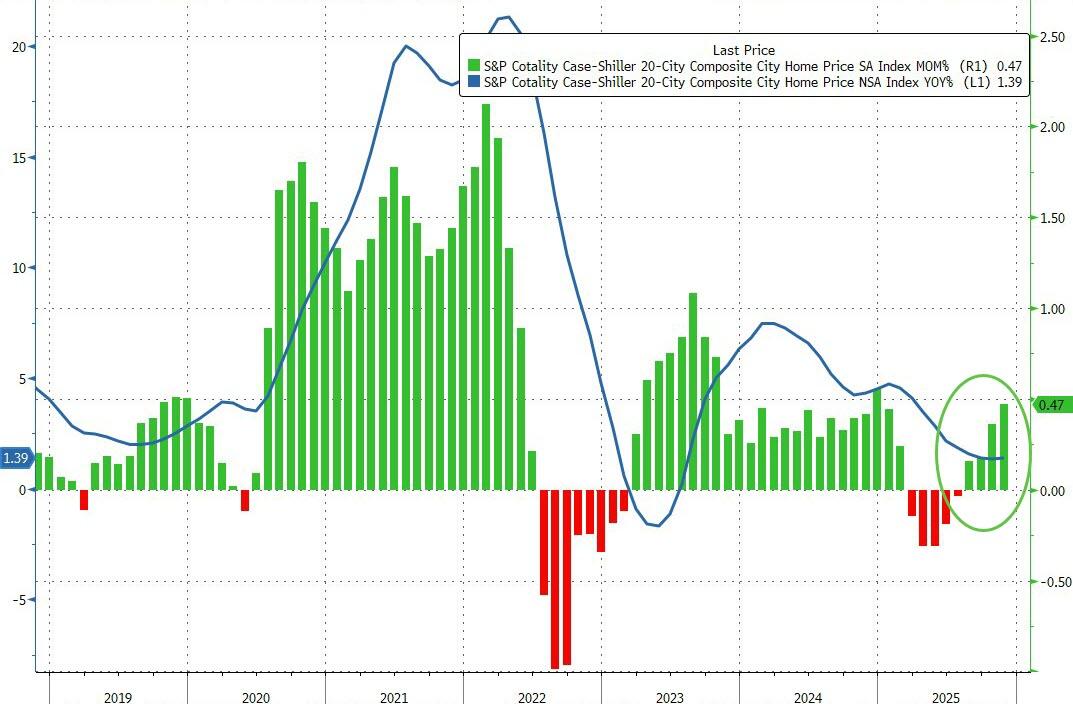
For the fourth straight month, US home prices rose on a MoM basis in November (according to the admittedly lagged and smoothed Case-Shiller data released today). The 0.47% MoM rise is the hottest since Dec 2024

Source: Bloomberg

On a year-over-year basis, there is a very modest inflection higher in the price appreciation (up from +1.32% to +1.39%).

"November's results confirm that the housing market has entered a period of tepid growth," said Nicholas Godec, CFA, CAIA, CIPM, Head of Fixed Income Tradables & Commodities at S&P Dow Jones Indices.

Regional patterns continue to illustrate a stark divergence.

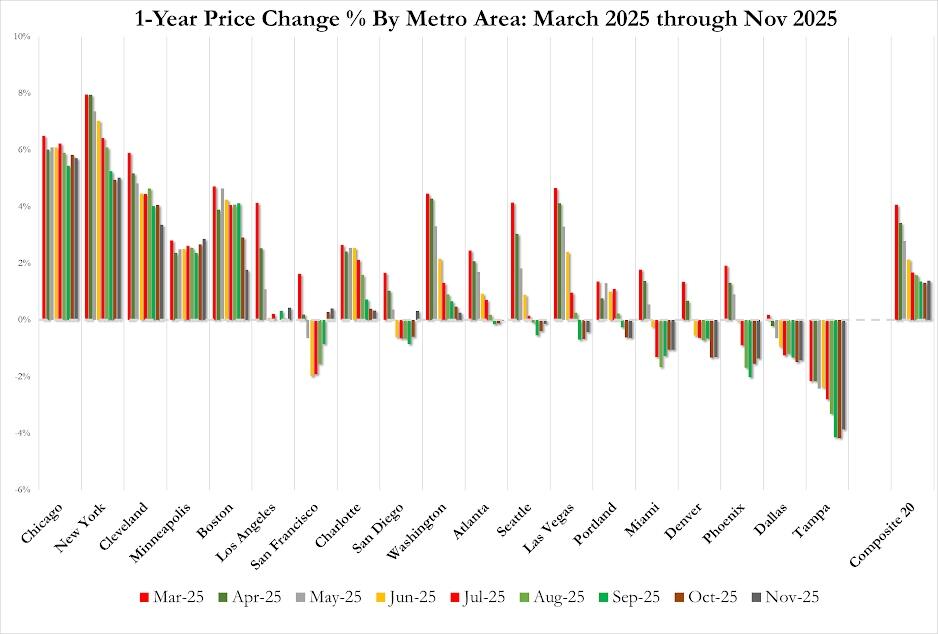
Chicago leads all cities for a second consecutive month with a 5.7% year-over-year price increase, followed by New York at 5.0% and Cleveland at 3.4%.

These historically steady Midwestern and Northeastern markets have maintained respectable gains even as overall conditions cool.

By contrast, Tampa home prices are 3.9% lower than a year ago – the steepest decline among the 20 cities, extending that market's 13-month streak of annual drops.

Other Sun Belt boomtowns remain under pressure as well: Phoenix (-1.4%), Dallas (-1.4%), and Miami (-1.0%) each continue to see year-over-year declines, a dramatic turnaround from their pandemic-era strength.

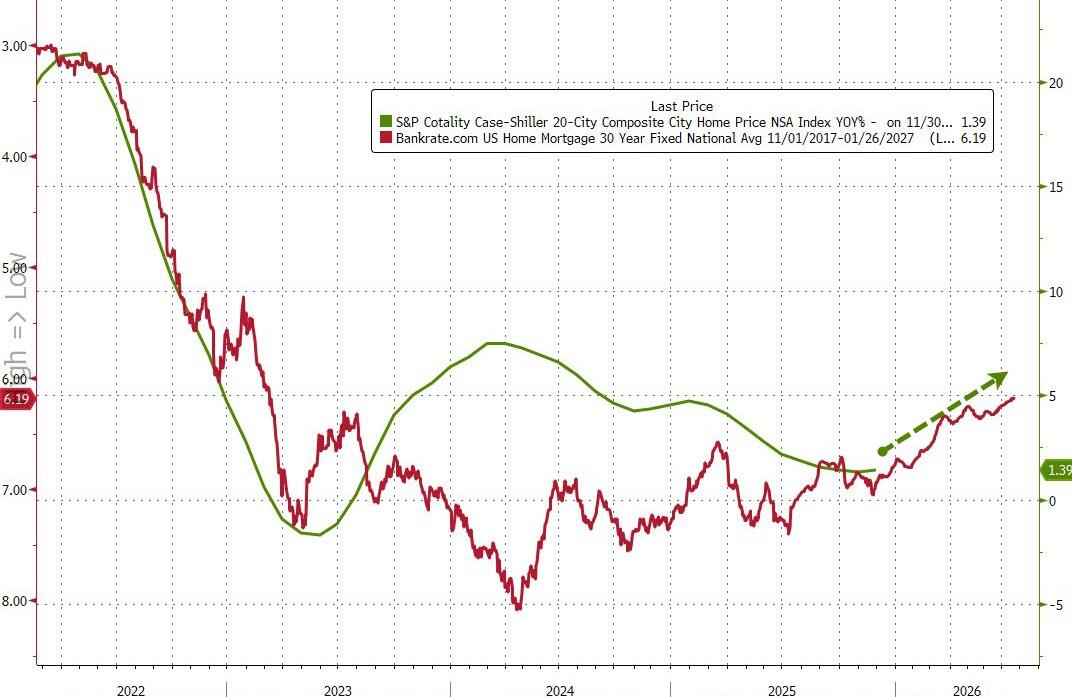
Declining mortgage rates suggest the rebound in aggregate prices could be about to explode...

Source: Bloomberg

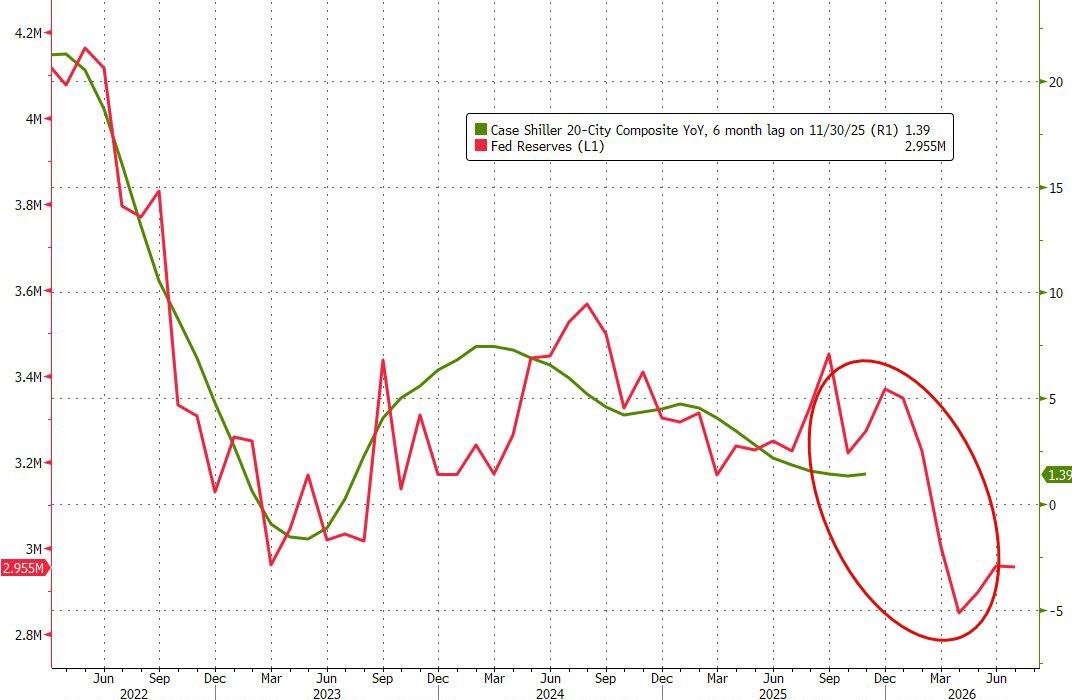
However, home price appreciation does seem to track very closely with bank reserves at The Fed (6mo lag), which implies prices are going continue to lag for the next few months...

Source: Bloomberg

Still, November's data is not exactly what President Trump is looking for from 'lower rates' helping his 'affordability' message.

Tyler Durden Tue, 01/27/2026 - 09:05
[syndicated profile] charter97_pol_feed
Киев намерен привлечь диктатора к ответственности за соучастия в агрессии РФ.

Рабочее

Jan. 27th, 2026 10:32 am
excubitus: (Default)
[personal profile] excubitus
В этом году заводик обновил систему оповещения о чрезвычайных ситуациях. EH&S разослал памятку перед штормом, что все должны на эту систему переподписаться, я переподписался.

Теперь система не только пишет SMS, но и звонит по телефону.
Получить в 5:18 утра в Бруклине звонок о том, что из-за сильного снегопада наша локация в Миссури закрывается - бесценно.

Заблокировал, а что делать.
natalia_il_1992: (ответ на загадку)
[personal profile] natalia_il_1992
Антиэрудит из сказок и однофамилец известного джазового музыканта.
Что у них общего?


ОТВЕТ: Побывали на Луне.

ПОЯСНЕНИЯ:

"Незнайка на Луне" — роман-сказка Николая Носова из серии о приключениях Незнайки.
Астронавт Нил Армстронг однофамилец Луи Армстронга джазового музыканта.

Раз уже начала

Jan. 27th, 2026 05:09 pm
julinona: (Default)
[personal profile] julinona
Новое видео от Геры:


https://youtu.be/LgIrbSzktXk?si=7VFuYhQjH-QEn_lU

Ьак что...
Думайте сами, решайте сами, кто прв, а кто виноват.
procol_harum: (Default)
[personal profile] procol_harum
1434944_original.jpg
Крайний справа - руководитель ГУЛАГа Нафталий Френкель

Установка такая: если убивали белые, да еще восхвалявшие арийскую расу, то здесь осуждение вечное и по полной программе, с чудовищными преувеличениями (напр., взятые из ближневосточной мифологии «шесть миллионов»), а если убивали в формате марксистского террора и уничтожения левыми цивилизации, то здесь не видим и не слышим. А еще есть такое: внутривидовая борьба, когда евреи мочили евреев (так надо по каким-то их законам).

Тут сначала еврейские энкаведешники расстреливали на Украине всех подряд, в т.ч. много евреев, а буквально в этом же году или чуть позже – в 1937-38 г.г. – их так же расстреляли. Но об этом в мире не шумят.

Пишет allin777: Лазарь Мунвез 2-го марта 1938 года подписывал запрос на лимиты по 1-й категории (расстрел) на 35.000 человек по Украине, а 25 сентября 1938 года его фамилия уже числилась под номером 7 в списке осужденных по 1-й категории (расстрел) Военной Коллегией Верховного суда. Под первым номером в этом списке приговоренных к расстрелу числится Лев Зиньковский-Задов (Лёвка Задов, бывший сподвижник Махно), а под номером три его брат Даниил (тоже все евреи).


Сегодня "день холокоста" отмечается?

См. также:

Некоторые мысли о блокаде Ленинграда (2014) Мне кажется, что советское государство спасало не людей, а советский, большевицкий строй, и оно как огня боялось соприкосновения советских людей с иностранцами. Ведь перед войной, по мере приближения к Ленинграду немцев, проводились зачистки: людей принуждали переезжать в Ленинград.


Шапка-невидимка для евреев (2015) Евреи всегда пытались замаскироваться, они как бы есть, но их как бы и нет, и они только вечные страдальцы. Евреям свойственна этническая мимикрия со сменой фамилий. Якобы проживание во враждебном окружении вынуждает их к этому.


Память и спекуляция (2016) Это очень хорошо, когда чтут память о погибших, к тому же невинно погибших. И плохо, когда память одних чтут в международном масштабе, а о других - совсем забывают. Или даже отрицают.


Война без концепции и ума (2019) Мне непонятна идея немецких правителей - переть на невероятные по своей обширности территории СССР. На что немцы рассчитывали? Ведь был уже Наполеон. Попытка проникнуть на земли России – это ловушка и западня. Похоже, что у Гитлера не было никакой концепции, никакого плана.


Эпидемия извинений (2020) Это уже действительно заставляет задуматься, что же такое происходит. Похоже на умопомрачение. И все молчат, критике никого не подвергают. Все по очереди, как болванчики, извиняются, извиняются перед евреями: Премьер Нидерландов впервые официально извинился за роль страны в Холокосте
1436012_300.jpg

Запад, ислам и повокации (2023) Тут опять заверещали, что сначала в Швеции сжигали Коран, потом в Дании. Тут же наши тупые овцы (по классификации «Протоколов») стали вопить, что в Швеции это путинские агенты, проплачено Кремлем, якобы чтобы Швеция не вступила в НАТО.


Украинская трагедия как анекдот (2024) А главное, что это не просто такой президент Кравчук попался, который ничего не мог предвидеть, который без тестостерона, и согласился выполнить самокастрацию. Это глубоко украинское, анархистско-пацифистское, селянское, «моя хата с краю», «к каком сюзерену пристроиться бы».
2760307_600.jpg

Подчиненные страны по команде отмечают дату (2025) Мне написали, что в Великобритании по ТВ сегодня сплошной Освенцим. Однако есть страны, которые не подчиняются или которые не особо подчиняются. Как правило, это восточноевропейские страны и в наибольшей степени – Польша. Где и располагался Освенцим / Аушвиц.

Flag Counter


Free Tools
don_katalan: (Default)
[personal profile] don_katalan
Чи це справді так? Сьогодні чимало досвідчених дипломатів, фахівців з міжнародних відносин і міжнародного права вважають, що поквапливий вступ до "Ради миру" на догоду Білого дому без вивчення усіх можливих наслідків може зіграти злий жарт з країнами-членами новоспеченої "міжнародної" організації. Так, приміром, долучення РФ до "Ради миру" стало для Кремля дипломатичною і політичною пасткою. Незважаючи на зовні ввічливе запрошення з боку Трампа, поставило Москву у вкрай невигідну позицію.
Перед Росією постала загрозу статусу, до якого Кремль звик через майданчик Ради Безпеки ООН. У Раді безпеки ООН Росія зберігає право вето і може блокувати і заганяти в "глухий кут" будь-які питання в Організації об'єднаних націй. Натомість у "Раді миру" такого механізму немає, і участь там означає перехід у категорію звичайних учасників без особливих прав та без можливості нав'язувати свій порядок денний. Read more... )
don_katalan: (Default)
[personal profile] don_katalan
В Петербурге уже вторые сутки заблокирован мобильный интернет из-за участия Путина в мероприятиях в честь годовщины снятия блокады Ленинграда.
=====
Alexey Kucherenko · Дивуюся українському «диву».
Те що в країні існує корупція - відомо кожному українцю, включно з дітьми.
Постійно відбуваються гучні корупційні скандали - в органах влади, в державних компаніях тощо.
І є лише два островки, вільні від корупції!
Два оазиси антикорупціонизму я би сказав!
Ви зараз здивуєтеся - це два енергетичних гіганти Нафтогаз та Укренерго!
За останні десять років спритні топ-менеджери обох компаній примудрилися загнати обидві компанії в фінансову прірву.
Держаудитслужба, яка робила аудит обох компаній, видала «на гора» дуже потужні звіти, де фіксувалися шалені багатомільярдні фінансові порушення з боку керівництва.Read more... )
[syndicated profile] charter97_pol_feed
Зэки и иностранные наемники — основной ресурс армии Кремля.

Profile

eledjo: (Default)
eledjo

June 2025

S M T W T F S
12 34567
891011121314
15161718192021
22232425262728
2930     

Page Summary

Style Credit

Expand Cut Tags

No cut tags
Page generated Jan. 28th, 2026 10:29 am
Powered by Dreamwidth Studios